Practical guide
Exactly One in Predicate Logic: Existence Plus Uniqueness
Exactly one requires a P witness and identity-based uniqueness. Compare zero, one and two P objects, then check why two names need not mean two objects.
On this page
Require a witness and rule out a second P object
Exactly one combines existence with at-most-one. A convenient formula is ∃x(Px∧∀y(Py→y=x)). The chosen x is P, and any y that is P must be the very same object.
Exactly one P:
∃x(Px ∧ ∀y(Py → y=x))

At most one P:
∀x∀y((Px ∧ Py) → x=y)
Identity x=y means sameness of object, not merely sharing properties. We use a nonempty domain and ordinary classical first-order logic with identity. Variables can range over the same object; having two variable letters does not force distinctness.
Check zero, one and two P objects
All three original models have the complete domain {A,B}. Their only difference is P’s extension: empty, {A}, or {A,B}. A and B identify distinct domain objects in these model descriptions.
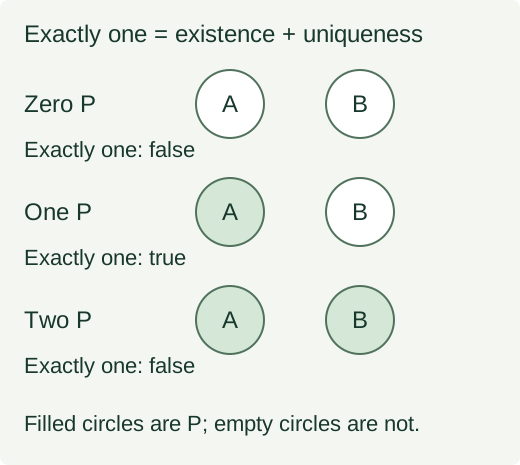
Download this original labelled diagram
On a narrow screen, scroll inside this table. Keyboard users can focus the region and use the arrow keys.
| P extension | P count | Some P | At most one P | Exactly one P |
|---|---|---|---|---|
| Empty | 0 | False | True | False |
| {A} | 1 | True | True | True |
| {A,B} | 2 | True | False | False |
Download every P membership in the three models
With zero P, the at-most-one conditional never encounters two P objects, so it is true. Existence fails. With one P, choose that object as x; every P y is identical to it. With two P objects, whichever x you choose, the other P y violates y=x.
Read each part of the compact formula
The outer ∃x supplies a proposed unique P. The first conjunct Px ensures the proposed object really has the property. The inner ∀y then examines all domain objects, but its conditional restricts the identity demand to objects satisfying Py.
Removing Px loses existence of a P. The formula ∃x∀y(Py→y=x) can be true when there are no P objects: choose any domain object for x and all the inner conditionals have false antecedents. Removing the inner universal loses uniqueness: ∃xPx only says one or more P objects exist.
Replacing Py→y=x with Py∧y=x would require every domain object to be P and identical to x. That restricts the whole domain to a singleton, which is stronger than exactly one P in an otherwise larger domain.
Definitions and rules: [1].
Do not count names as distinct objects
Suppose constants a and b both refer to A in a domain containing A and B, and P holds only of A. Then Pa and Pb are both true, but there is still just one P object. The interpretation permits more than one name for the same object.
At least two P objects:
∃x∃y(Px ∧ Py ∧ x≠y)
The inequality is essential. ∃x∃y(Px∧Py) can use the same object for both witnesses. For three distinct witnesses, every pair must be unequal; merely writing x≠y and y≠z does not rule out x=z.
Definitions and rules: [1].
In ordinary reading, a story’s two character names or a spreadsheet’s two labels might refer to the same entity. Verify the identity question before treating label count as object count. The formal example is not an entity-resolution method for real data.
Keep property uniqueness separate from domain size
Exactly one P does not say exactly one object exists. In the middle model, two objects exist and only A is P. A large or infinite domain can likewise contain exactly one P.
Conversely, a one-object domain does not by itself ensure exactly one P: its sole object might not be P. You need the property claim too. Keep the domain and P extension as separate lines in the interpretation key.
Use the full formula when a later statement depends on the unique object, such as Russell’s analysis of a definite description. Do not assume a phrase like “the P” has already secured existence and uniqueness under every theory of language.
Try three identity checks
Assess objects and predicate membership, rather than the number of written labels.
Case 1
There are no P objects in a two-object domain. Is at most one P true?
Show answer and explanation for case 1
Yes, but exactly one P is false.
No two distinct P objects violate at-most-one. The separate existence requirement fails.
Case 2
Pa and Pb are true and a=b. Have you established at least two P objects?
Show answer and explanation for case 2
No.
The two names denote the same object. At least two requires distinct witnesses, expressed by inequality.
Case 3
Does exactly one P imply the domain has one object?
Show answer and explanation for case 3
No.
The model D={A,B}, P={A} satisfies exactly one P while containing two domain objects.
Sources and further reading
- forall x: Calgary, chapter 26: IdentityFormal background in S1, S3, S4, S5. The records, explanations and worked examples on this page are original additions, rather than copied textbook exercises.
- forall x: Calgary, chapter 31: Truth in FOLFormal background in S1, S2, S3. The records, explanations and worked examples on this page are original additions, rather than copied textbook exercises.
- forall x: Calgary — credits, editions and CC BY 4.0 licenseBased on work by P. D. Magnus and Tim Button, revised and expanded by Aaron Thomas-Bolduc and Richard Zach, with further contributions credited by the textbook. Referenced HTML revision: Fall 2025, bb86fe9 (2026-10-22). No author endorsement is implied.