Practice worksheet
Valid and Sound Arguments: 10 Worked Examples and a Worksheet
A valid deductive argument guarantees its conclusion if its premises are true. A sound argument also has premises that are actually true. Work through ten original examples to separate those checks, including a true conclusion reached by an invalid form and a valid argument whose premise truth remains unverified.
What valid and sound mean
Validity concerns the connection between premises and conclusion. Ask whether every premise could be true while the conclusion is false. If such a situation is possible, the argument is invalid. If none is possible under the stated logical interpretation, the argument is valid. One successful instance does not establish a guarantee.
Soundness requires validity and true premises. An invalid argument is unsound. A valid argument with a false premise is also unsound. A sound argument must have a true conclusion, but a true conclusion alone cannot show that the argument is sound. Cases 3, 4 and 8 make that distinction visible.
The words apply here to deductive arguments. We are not evaluating the strength of an inductive forecast, the soundness of an entire proof system or the truth of a single formula. Those are different tasks. For the guarantee-versus-estimate distinction, use the deductive and inductive reasoning worksheet.
Use this two-step judgment diagram
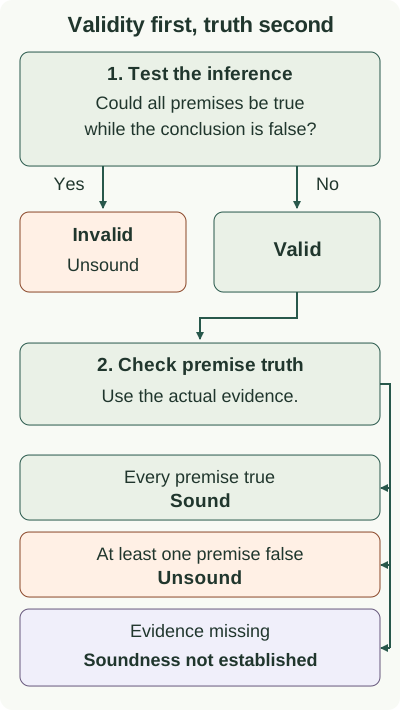
“I could not think of a counterexample” is weaker than “none is possible.” For a small propositional form, inspect every truth-table row. For other forms, use an appropriate proof or countermodel. Familiar vocabulary and confidence in the speaker are not substitutes for this check.
At the second step, seek evidence for each premise. A record may establish what happened in a fictional exercise; a real argument may require a current log, a source or clarification of a disputed principle. If the evidence is incomplete, report that limit. Soundness remains an objective property; “not established” describes what you can responsibly claim about it.
Compare validity with premise and conclusion truth
| Inference | Actual premises | Actual conclusion | Soundness |
|---|---|---|---|
| Valid | All true | Must be true | Sound |
| Valid | At least one false | May be true or false | Unsound |
| Invalid | All true | May be true or false | Unsound |
| Invalid | At least one false | May be true or false | Unsound |
| Valid | Truth not established | Not guaranteed by the evidence available to you | Not established |
“May be true or false” describes what that combination of labels permits across arguments; it does not say every particular argument has both possibilities. The last row concerns incomplete knowledge, not a third logical truth value. If you independently verify a conclusion, that still does not verify every premise or validate the offered inference.
How to read the ten examples
For each original fictional case, write (1) whether the form is valid and why; (2) which premises are true, false or unverified in the supplied record; and (3) whether soundness is established. For an invalid form, supply a situation with every premise true and the conclusion false. A false premise is not a counterexample to validity. Use classical propositional logic, the material conditional and inclusive or. Unknown evidence does not make a claim false. Records are only for the truth check; do not add them as premises.
For these exercises, “if p then q” uses the material conditional: it is false only when p is true and q false. It does not assert causation, timing or that p actually occurred. “p or q” is inclusive: either or both may be true. Natural-language uses of “if” and “or” can require a different analysis; state the interpretation before judging their form.
Cases 1–3 deliberately hold one valid form fixed while changing the record. Cases 4–6 contrast three easily confused conditional patterns. Cases 7–8 show what inclusive “or” allows. Cases 9–10 address missing truth evidence and a conditional conclusion.
Download the ten questions without answers · Download the explained answer key. Try a question before opening its answer. Write the counterexample or inference reason, not just “valid” or “invalid.”
Ten worked examples and self-test answers
Case 1
Fictional dispatch record A: parcel N is sealed and scanned. P1: If N is sealed, N is scanned. P2: N is sealed. C: N is scanned. Treat this record as the complete supplied evidence about these two properties. Is the argument valid? Is it sound in this scenario?
Show answer and explanation for case 1
Valid and sound in record A. Both premises and the conclusion are true.
The form is modus ponens: if p then q; p; therefore q. If both premises are true, p holds and the conditional rules out p being true with q false. The supplied record makes P1 and P2 true, so this particular instance also passes the truth check. This does not establish that any actual dispatch company follows such a rule. The record is a stipulated classroom situation, not a field observation.
Case 2
Fictional dispatch record B: parcel N is sealed but not scanned. Use exactly the same argument: P1: If N is sealed, N is scanned. P2: N is sealed. C: N is scanned. What changed from case 1: the inference form, the truth of a premise, or both?
Show answer and explanation for case 2
Valid but unsound in record B. P1 is false, P2 is true and C is false.
The modus ponens form has not changed. Validity asks what follows if all premises are true; it does not certify their truth. Record B contradicts P1 because it supplies a sealed, unscanned parcel. That explains the false conclusion without showing a defect in the inference form. Record B is not a counterexample to validity: a logical counterexample must keep every premise true, and here P1 is false.
Case 3
Fictional dispatch record C: parcel N is not sealed, but it is scanned. Again, P1: If N is sealed, N is scanned. P2: N is sealed. C: N is scanned. Evaluate this classroom conditional using the truth-table convention explained below. Does the true conclusion make the argument sound?
Show answer and explanation for case 3
Valid but unsound in record C. P1 is true under this convention, P2 is false and C is true.
This is the third instance of the same valid form. The supplied record makes P2 false, so soundness fails even though the conclusion happens to match the record. Under the material-conditional convention, “if p then q” is false only when p is true and q false; with p false and q true, it is true. Do not silently read P1 as a causal claim or a claim that scanning happens only after sealing. Neither interpretation is part of this exercise.
Case 4
Return to record A: N is sealed and scanned. P1: If N is sealed, N is scanned. P2: N is scanned. C: N is sealed. All three statements match this record. Is this enough to establish validity and soundness?
Show answer and explanation for case 4
Invalid and therefore unsound, despite all premises and C being true in record A.
This form affirms the consequent: if p then q; q; therefore p. A counterexample is an unsealed but scanned parcel, as in record C. In that alternative situation P1 and P2 are true while C is false. The conditional gives a sufficient condition for scanning; it does not make sealing necessary. A true instance cannot rescue an invalid form. The counterexample tests the stated argument, not whether the original record was accurately copied.
Case 5
Use record C: N is not sealed but is scanned. P1: If N is sealed, N is scanned. P2: N is not sealed. C: N is not scanned. Test the inference first, then compare each statement with the supplied record.
Show answer and explanation for case 5
Invalid and unsound. Both premises are true under the stated convention, while C is false.
The form denies the antecedent: if p then q; not p; therefore not q. The conditional permits scanning in the absence of sealing. Record C itself is a counterexample with all premises true and the conclusion false. For this form, the fact that sealing did not happen leaves scanning open. Adding “N is scanned only if N is sealed” would change the premises; it would not vindicate the argument as originally written.
Case 6
Fictional dispatch record D: N is neither sealed nor scanned. P1: If N is sealed, N is scanned. P2: N is not scanned. C: N is not sealed. Compare this argument with case 5: which part of the conditional is denied?
Show answer and explanation for case 6
Valid and sound in record D. This is modus tollens.
The form is if p then q; not q; therefore not p. If p were true, P1 would require q, contradicting P2. Consequently not p follows. Record D makes both premises true and makes C true. Case 5 denies p and then denies q; this case denies q and then denies p. That difference determines validity. The similar wording does not make the two inferences interchangeable.
Case 7
A fictional notification record says that notice J was printed and was not emailed. P1: J was emailed or printed, or both. P2: J was not emailed. C: J was printed. Is the explicitly inclusive “or” a problem for this inference?
Show answer and explanation for case 7
Valid and sound in the supplied notification record.
This is disjunctive syllogism: p or q; not p; therefore q. The first premise requires at least one of the two alternatives. The second removes p, leaving q. Allowing both alternatives in P1 does not undermine this inference, because P2 already excludes emailing. The record establishes the truth of both premises. The conclusion follows without changing inclusive “or” into exclusive “or.”
Case 8
A different fictional record says notice K was emailed and not printed. P1: K was emailed or printed, or both. P2: K was emailed. C: K was not printed. C is true in this record. Does it follow from P1 and P2?
Show answer and explanation for case 8
Invalid and unsound, even though both premises and C are true in this record.
The premises also allow a notice that was both emailed and printed. In that counterexample P1 and P2 stay true while C becomes false. An inclusive “or” does not let you deny one alternative merely by affirming the other. If the record’s “not printed” fact is added as a premise, the conclusion follows trivially from that new premise. It was not a premise in the displayed argument; background information used to check truth must not be smuggled into the validity test.
Case 9
A fictional archive note asserts P1: report Z has been checked and filed. C: Report Z has been checked. No check log or filing record is supplied, and you cannot determine whether P1 is true. Assess the inference, then state precisely what the missing evidence prevents you from concluding.
Show answer and explanation for case 9
Valid; soundness is not established from the supplied evidence.
Conjunction elimination has the form p and q; therefore p. If the conjunction is true, each part is true, so this form is valid. The truth of P1 is unknown to the learner. That does not make P1 false and does not create a third logical truth value. If P1 is actually true, this argument is sound; if it is false, the argument is unsound. The justified report now is “valid, premise truth unverified,” followed by a request for the actual check and filing evidence.
Case 10
A fictional three-event record says a parcel was not checked, was filed and received a receipt. P1: If it was checked, it was filed. P2: If it was filed, it received a receipt. C: If it was checked, it received a receipt. Evaluate the two conditionals using the same classroom convention. Does the conclusion assert that checking actually occurred?
Show answer and explanation for case 10
Valid and sound in this record. The conclusion is a conditional, not an assertion that checking occurred.
The form is if p then q; if q then r; therefore if p then r. Assuming p, P1 gives q and P2 gives r. There is no assignment with both premises true and the conditional conclusion false. In this supplied record p is false, q and r true; both premises and the conclusion are true under the stipulated convention. Do not replace C with “it received a receipt because it was checked”: that introduces an occurrence and a causal claim absent from the argument.
Check the conditional forms with four truth-table rows
Let p mean “N is sealed” and q mean “N is scanned.” T and F mean true and false. The “both premises” columns ask whether every premise of that form is true in the row.
| p | q | If p then q | Modus ponens: both premises true? | Its C: q | Affirming consequent: both premises true? | Its C: p |
|---|---|---|---|---|---|---|
| T | T | T | T | T | T | T |
| T | F | F | F | F | F | T |
| F | T | T | F | T | T | F |
| F | F | T | F | F | F | F |
For modus ponens, only the first row has both premises true; its conclusion q is true. For affirming the consequent, the first and third rows have both premises true. The third row has p false, so it supplies the needed counterexample. Checking only the first row would miss that failure.
The second row makes the conditional itself false. It therefore cannot refute either form’s validity: their premises are not all true there. This is why record B in case 2 does not disprove modus ponens. Change the form, or change the truth of an instance, and record which change you made.
Apply the method to an argument you encounter
- Copy the exact conclusion. Preserve its scope and negation. “If checking occurs, a receipt follows” differs from “checking occurred.”
- List the offered premises. Separate them from information you happen to know. Mark an unstated connecting premise as a proposed addition.
- Make the interpretation explicit. Decide what “or,” “if,” “all” and key terms mean in context. Changing a word’s meaning midway changes the argument.
- Test the guarantee. A counterexample must preserve every premise and falsify that exact conclusion. Show why each premise survives.
- Check truth independently. Record evidence, a false premise or an unresolved question. Do not turn unavailable evidence into a negative finding.
Finding a bad argument for a conclusion does not prove the conclusion false. You may need a different argument, better evidence or a revised claim. Similarly, finding a false premise in a valid argument shows why this argument is unsound; it does not refute the inference pattern shared by other instances.
For a study-group discussion, ask one person to propose a counterexample and another to audit every premise in it. Use cases 4 and 8 to catch hidden premises, and cases 2 and 9 to distinguish a demonstrated falsehood from an evidence gap. The examples and records are original teaching constructions. No real dispatch records, professional review or measured learning outcomes are claimed.
Sources and further reading
- Internet Encyclopedia of Philosophy: Validity and SoundnessDefinitions of valid and sound deductive arguments, true conclusions in unsound arguments, counterexamples and the need to specify logical form. Read the complete entry; the ten examples and diagram here are original.
- OpenStax, Introduction to Philosophy, section 5.3: ArgumentsPremise and conclusion identification, separate logical and truth analysis, and conditional chains. Read the complete section.
- OpenStax, Introduction to Philosophy, section 5.4: Types of InferencesThe deductive-reasoning portion: modus ponens, modus tollens, disjunctive syllogism, affirming the consequent, denying the antecedent and counterexamples. The rest of the chapter is not needed for this worksheet.
Move from validity to quantified models and proofs
Work through domain restriction, witness order, uniqueness, variable scope and the conditions on natural-deduction rules.