Practical guide
Quantifier Order: Every Object Has a Witness vs One Shared Witness
A different witness for each object is weaker than one witness shared by all. Complete two-object matrices show the distinction and the valid direction.
On this page
Read the witnesses in the order required
Quantifier order changes what counts as a witness. In ∀x∃yRxy, first take an arbitrary x; then find a y related to that x. You may use different y objects for different x objects. In ∃y∀xRxy, choose one y first; it must work for every x.
We use classical first-order logic with a nonempty domain and a two-place relation R. Rxy means that the ordered pair (x,y) belongs to R. It is not automatically symmetric, and the two variables may refer to the same object unless you add a distinctness condition.
Definitions and rules: [1] [2].
For every x, some y:  ∀x∃yRxy
One y for every x:   ∃y∀xRxy
The outermost quantifier is read first. Moving ∃y in front of ∀x is a stronger commitment about one shared object, not a harmless change of notation.
Inspect all pairs in three original models
All three deliberately constructed models have the domain {A,B}. A and B are labels for two distinct domain objects here. A true cell records membership in the relation. Every other cell is false; there are no unknown or omitted cells.
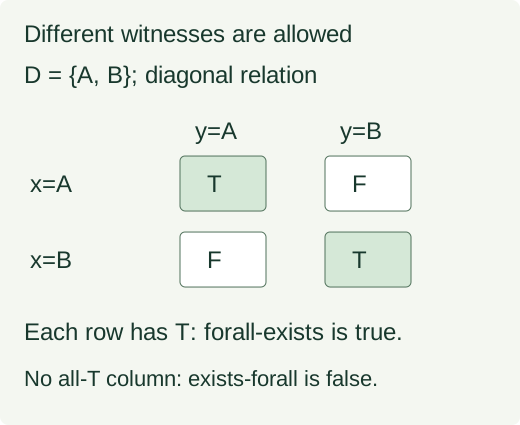
Download this original labelled diagram
On a narrow screen, scroll inside this table. Keyboard users can focus the region and use the arrow keys.
| Model | R(A,A) | R(A,B) | R(B,A) | R(B,B) |
|---|---|---|---|---|
| Diagonal | T | F | F | T |
| Shared A | T | F | T | F |
| Failed B row | T | T | F | F |
Download every ordered pair in the three models
In the diagonal model, A can choose A and B can choose B. That makes ∀x∃yRxy true. But choosing A as the shared y fails at x=B, and choosing B fails at x=A. There is no third object available. Thus ∃y∀xRxy is false.
Check every row, then look for one complete column
On a narrow screen, scroll inside this table. Keyboard users can focus the region and use the arrow keys.
| Model | Each row has T? | One column is all T? | ∀x∃yRxy | ∃y∀xRxy |
|---|---|---|---|---|
| Diagonal | Yes | No | True | False |
| Shared A | Yes | Yes: A | True | True |
| Failed B row | No: B has no T | No | False | False |
For the shared-A model, y=A works for both x values. The second formula is true, and each row consequently has a witness too. For the failed-B-row model, B has no related y at all. Both claims fail.
Do not count total true cells as a substitute for their positions. The diagonal and shared-A models each contain two true cells, but only the shared-A model has a shared witness. Distribution across rows and columns is the decisive information.
Explain the valid direction beyond the small example
The implication from ∃y∀xRxy to ∀x∃yRxy holds for any interpretation, including an infinite domain. Suppose a single object d satisfies R(x,d) for every x. For any particular x, that same d is an available existential witness. Therefore every x has some y. This argument does not depend on the domain having two objects.
The reverse implication fails because the diagonal interpretation makes its premise true and its conclusion false. One complete countermodel suffices to refute an inference claimed to be valid. Merely testing many models where the inference happens to work would not establish validity.
Definitions and rules: [3].
This is why “there were two successful examples” is weaker evidence than the general witness argument. Use the examples to understand the distinction; use an all-interpretation argument or a licensed proof for the valid direction.
Keep the intended relation and distinctness explicit
If Rxy means “x is assigned reviewer y,” the first sentence allows separate reviewers for separate submissions. The second requires one reviewer assigned to every submission. That is a constructed interpretation of the wording, not a claim about a real review system.
If an object must have a different partner, write ∀x∃y(y≠x∧Rxy). The diagonal relation would then stop being an example of success. A self-related object was allowed in our original formulas, so silently adding “someone else” changes the task.
Likewise, do not replace Rxy with Ryx while rearranging the quantifiers. That changes the direction of the relation as well as its witness requirements. Work from a written domain and interpretation key before evaluating a formula.
Try three witness checks
Use the complete domain {A,B} and the displayed relation cells.
Case 1
The diagonal has two true cells. Does that prove one shared witness exists?
Show answer and explanation for case 1
No.
Neither column is all true. A works only for A, and B works only for B; total cell count does not establish a shared witness.
Case 2
In any interpretation, can a shared witness be reused for every individual existential choice?
Show answer and explanation for case 2
Yes.
If R(x,d) holds for every x, use d for the existential claim for each x. This explains the valid direction without restricting domain size.
Case 3
If the formula also requires y≠x, does the diagonal still satisfy every x has some y?
Show answer and explanation for case 3
No.
Its only true cells are self-pairs. The added inequality removes both witnesses; it is an additional condition, not a paraphrase of the original formula.
Sources and further reading
- forall x: Calgary, chapter 25: Multiple generalityFormal background in S1, S3, S4. The records, explanations and worked examples on this page are original additions, rather than copied textbook exercises.
- forall x: Calgary, chapter 31: Truth in FOLFormal background in S1, S2, S3. The records, explanations and worked examples on this page are original additions, rather than copied textbook exercises.
- forall x: Calgary, chapter 34: Semantic conceptsFormal background in complete explanatory chapter, excluding practice exercises. The records, explanations and worked examples on this page are original additions, rather than copied textbook exercises.
- forall x: Calgary — credits, editions and CC BY 4.0 licenseBased on work by P. D. Magnus and Tim Button, revised and expanded by Aaron Thomas-Bolduc and Richard Zach, with further contributions credited by the textbook. Referenced HTML revision: Fall 2025, bb86fe9 (2026-10-22). No author endorsement is implied.