Practical guide
Descartes' Wax Argument Explained Step by Step
Follow the changing wax through Meditation II: distinguish sensory appearances, identity judgment, imagination, intellectual understanding and the return to the thinking self. Use the original map and exercises to keep the argument’s conclusions precise.
What is the wax argument trying to show?
In the Second Meditation, Descartes considers a piece of wax whose sensory characteristics alter near a fire. He still treats it as the same wax. The question is how he understands that body when its particular color, smell, hardness, shape and sound no longer supply the earlier picture. He argues that understanding the wax as an extended, changeable body depends on the intellect, rather than being exhausted by sense perception or a finite collection of imagined shapes.
The passage then turns back to the thinker. Whatever contributes to judging that the wax exists also makes the occurrence of thinking apparent. Even if the apparent wax is doubtful, the thinking involved in seeming to perceive or judging it cannot simply disappear. Descartes uses this to support the Second Meditation’s theme that the mind is better known than body. Those are connected claims, but they are not identical conclusions.
For a first reading, keep two questions on your page: what is involved in understanding the wax, and what does that understanding reveal about the thinking self? Neither question is answered adequately by saying that the senses are bad and reason is good. The argument challenges a particular account of bodily knowledge; it does not forbid observing things, supply a chemistry experiment or prove the whole of Cartesian metaphysics in one paragraph.
Locate the passage inside Meditation II
The wax appears after the meditator has raised radical doubts and found that his existence cannot be denied while he is thinking. He has not yet secured an external world. He asks what this thinking self is and includes doubting, understanding, affirming, denying, willing, imagining and sensing in the relevant account of thought. In this setting, sensing in a restricted sense means having a conscious seeming, even when the apparent object might be absent.
The obstacle is familiar: bodily things seem easier to picture than the self. The meditator is drawn back toward objects touched and seen. He therefore allows himself to consider one particular body rather than starting with an abstract definition of all bodies. The wax is a strategically chosen case because dramatic alterations leave the ordinary judgment of persistence intact. The passage asks the reader to investigate a seeming advantage of bodily knowledge, then reconsider that advantage.
Read this as a staged inquiry. A claim held under methodical doubt is not equivalent to a final demonstration that its object is unreal. Likewise, the later arguments about God, the reliability of clear and distinct perception, external bodies and mind–body distinction should not be imported as premises already established at this point. The SEP account of Descartes’ epistemology helps distinguish these stages and the interpretive issues around them.
Step 1: compare the wax before and after heating
At the beginning, the wax has a cluster of familiar characteristics: a residual taste of honey, a scent associated with flowers, a visible shape and size, a cold and hard feel, and a sound when struck. Near the fire those features alter. Descartes asks whether it is nevertheless the same wax and treats the answer as agreed. This is the crucial pivot from describing appearances to accounting for a body’s identity and nature.
Make two columns before interpreting the passage. In one, list the reported characteristics and changes. In the other, record the judgment that the wax persists. The first column does not contain an unchanged sensory portrait that settles the second. Yet the second is not presented as an observation of a hidden permanent color or scent. Descartes asks what understanding brings to the case once the initially familiar sensory bundle is insufficient.
The example’s philosophical usefulness does not require you to reproduce heating wax at home. Nor should a classroom paraphrase add measurements, claim a particular melting temperature or assert that the volume stays constant. The text’s point concerns what the meditator takes himself to understand through change. Treat the alterations as features of the narrated example and reserve scientific questions about real samples for evidence suited to those questions.
Step 2: separate observations, judgments and conclusions
An observation/inference table is a reading aid, not a claim that ordinary perception occurs in neatly separated conscious steps. Descartes’ own discussion complicates the boundary: what people casually call seeing an object can already involve judgment. Use the table to keep different claims visible while you evaluate the passage, rather than assuming that the first column describes a philosophically neutral theory of perception.
| Claim in the reading | How to classify it | What it does not establish |
|---|---|---|
| The fresh wax is hard and cold. | A sensory description in the story. | It is not a definition of what every possible state of this body must be. |
| Near the fire, its shape changes. | A reported alteration of appearance. | A change of shape does not by itself establish replacement of the object. |
| This remains the same wax. | The meditator’s identity judgment, accepted in the example. | It motivates the inquiry; the passage is not a general physical identity test. |
| It can take more forms than I can picture. | A claim about understanding possibilities and the limits of imagining them. | It is not an observation of infinitely many transformations. |
| I understand a body occupying space. | An intellectual characterization, in Descartes’ account. | It does not assert a fixed volume, current shape or external existence. |
| I judge that people cross the square. | An example of judgment involved in ordinary seeing. | It does not show that those particular people are robots or that all seeing is false. |
| Even if I am mistaken, I am thinking. | The return to the thinking self. | It supports epistemic priority without proving every mental judgment correct. |
The strongest place to question the argument is often a transition between rows. Does accepting persistence require the particular intellectual account Descartes proposes? Does understanding possible shapes establish a concept whose content is independent of experience? Does the occurrence of judgment justify the full claim that mind is more distinctly known? A critical reader can accept part of the example while asking for support at one of these transitions.
Step 3: distinguish extension from an imagined shape
Descartes describes what remains intelligible as extension, flexibility and changeability. Extension here concerns being spatial: a body occupies space and can have determinate shapes and dimensions. It does not name one permanently preserved size. The wax can spread, enlarge or alter its figure while still being considered as a spatial body. The distinction is between a capacity or nature and one current realization of it.
The imagination supplies particular pictures. You may picture the wax round, then square, then triangular. Each image has a determinate form, while the understood body can undergo far more transformations than those pictures present. Descartes argues that a finite succession of imagined figures is not the same as grasping that open-ended changeability. The intellect is his proposed explanation of the difference, not simply the ability to produce a sharper mental photograph.
There is a genuine issue to evaluate here. From the incompleteness of a picture collection, it does not immediately follow that all intellectual content must be innate or independent of learning. A critic could describe an acquired concept or general rule that is not identical to any one picture. Descartes’ account must therefore be assessed at the level of how the concept is understood and justified. Merely agreeing that three images are not exhaustive does not settle the whole rationalism–empiricism dispute.
Read one short phrase, then reconstruct the argument
Jonathan Bennett’s modernized English renders the relevant claim as it is purely a scrutiny by the mind alone
. This short excerpt comes from Meditation II, printed page 7, in the Meditations 1 and 2 PDF linked by Early Modern Texts; it is PDF page 8. Bennett’s wording and editorial aids are a modern adaptation, so label that version when quoting it. Consult the surrounding passage rather than treating this isolated phrase as the entire argument.
The phrase concerns how the wax is perceived or understood in the sense under discussion. Descartes does not introduce a second, purely mental wax replacing the visible object. He says the object under consideration is the one previously touched, seen and imagined, while revising the account of how its nature is grasped. The strength of the word alone should be attributed to his claim and then examined, not softened into a trivial statement that thinking is sometimes helpful.
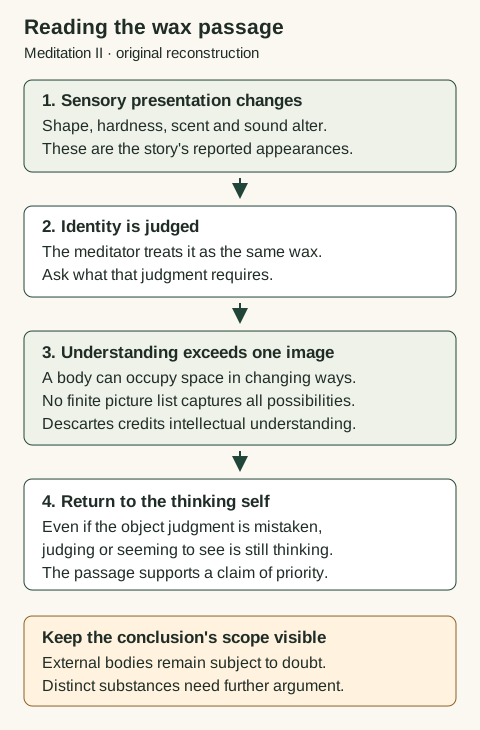
Read the final warning box before writing a conclusion. A map can make a sequence memorable while concealing an unsupported leap. In particular, a claim about understanding a body and a claim about the occurrence of thought do not, without further premises, yield the existence of an external body or the real distinction of substances. Those conclusions need their own arguments.
Step 4: follow judgment back to the thinking self
Descartes adds the example of people crossing a square. Ordinary language says that he sees people; the visible hats and coats could, however, conceal something else. He judges that people are there. The point is not that the actual passersby have been exposed as machines. It is that an ordinary report of seeing can include a judgment whose contribution is easily hidden by everyday wording.
This example helps the wax discussion move from a particular object to the activity of the perceiver. If I judge that wax exists because I seem to see it, the object claim could be mistaken. Yet that same event makes thinking apparent. The meditator takes this asymmetry to favor knowledge of himself over knowledge of the body. Keep the act and its object distinct: a false belief about an object is still an occurrence of believing or judging.
The SEP discussion of self-knowledge, section 9.1 also notes disagreements over direct and indirect interpretations of Descartes’ perception theory. This guide does not resolve those disputes. The immediate reading task is to recognize the passage’s claim of epistemic priority without converting it into an uncontested modern theory of vision, or a claim that every thought about oneself is infallible.
Test three objections without changing the target
First: is identity being assumed? The example takes agreement about the same wax as its starting point. A critic can ask whether that agreement relies on tracking, memory and learned expectations about changes. This objection targets the proposed explanation of recognition. It does not require asserting that the wax must have been replaced. A useful response distinguishes a thought experiment’s accepted setup from a general proof of what makes objects persist.
Second: does judgment require rationalism? An empiricist can accept that recognition involves conceptual organization while explaining the concepts through experience, including reflection on mental operations. The SEP comparison of rationalism and empiricism stresses that experience and reasoning are not two activities allocated to exclusive camps. The dispute concerns the sources and warrant of knowledge or concepts in a specified domain. Descartes’ stronger explanation needs assessment; the mere presence of reasoning does not establish it.
Third: is the imagination characterized too narrowly? If imagination means a sequence of determinate pictures, the open-ended capacity of the wax exceeds the displayed pictures. A critic may ask whether imagination can instead involve capacities, rules or transformations. That challenges the faculty distinction doing work in the argument. It is more precise than saying people can imagine lots of things, because lots of images can still fail to capture the claim of indefinite possibilities.
For each objection, name what you grant before stating what you deny. Granting changes in sensory appearance does not grant that intellect alone gives the relevant understanding. Granting intellectual contribution does not grant an innate origin. Granting a thinking self’s certainty at this stage does not grant substance dualism. Tracking these levels produces a stronger discussion than offering a single sweeping verdict that the wax argument succeeds or fails in every possible respect.
Eight reading checks with explained answers
These are original exercises about the passage, not historical quotations. Try stating the exact claim that needs repair before opening each answer. The aim is to identify a change in scope, a hidden assumption or a difference between an appearance, a concept and an existence claim.
Case 1
A student says the wax keeps exactly the same volume, so extension is unchanged. What needs correcting?
Show answer and explanation for case 1
Extension concerns occupying space, not preserving a fixed measurement.
The passage explicitly allows the wax to increase in size and take different forms. The relevant contrast is between this particular size or shape and understanding a body as extended and capable of alteration. An unchanged volume is neither supplied as the identity test nor established by the story. Replace the sentence with: the meditator understands the wax as a spatial body whose determinate dimensions can change. This is a reconstruction of the philosophical claim, not a scientific measurement of a heated sample.
Case 2
The wax looks different after heating. Does that alone prove that a different object has replaced it?
Show answer and explanation for case 2
No. Different appearances and different objects are distinct claims.
Within the passage, Descartes assumes ordinary agreement that this is the same wax. His question concerns how we grasp it despite the alteration. A replacement could be described in another story, but it would change the example and require new evidence. The present story does not give a general identity algorithm. Keep track of which claim is stipulated, which appearances are reported and which explanatory conclusion Descartes draws. That separation lets you criticize the identity assumption without pretending the original passage denies it.
Case 3
You picture a circle, a square and a triangle. Have you thereby represented every possible shape of the wax?
Show answer and explanation for case 3
No. Three imagined shapes illustrate possibilities without exhausting them.
The philosophical issue is the gap between depicting some determinate forms and understanding an open range of possible forms. Adding a fourth mental picture does not remove that gap. Descartes uses it to distinguish intellectual grasp from imagination understood as picturing. This supports his explanation only if that account of imagination and understanding is accepted. A critic may instead propose a general imaginative capacity or an experience-derived rule. State that proposal explicitly rather than dismissing the argument merely because the first three pictures were incomplete.
Case 4
Someone describes the conclusion as: the senses always lie, so every sensory report is false. Is that faithful?
Show answer and explanation for case 4
No. The passage analyzes the contribution and limits of sensory presentation.
A changed shape can be accurately reported as changed. Descartes asks why such a report does not, by itself, account for understanding the persisting body. Methodical doubt also withholds assent from doubtful beliefs; it does not demonstrate their universal falsity. The stronger slogan confuses failure to provide the desired certainty with proof of deception in every case. A more careful account says that sensory characteristics are not, for Descartes, the whole basis of a clear understanding of body.
Case 5
An essay says: because the wax is grasped intellectually, it certainly exists outside the mind. What step is missing?
Show answer and explanation for case 5
Understanding a body does not, by itself, establish its external existence.
The Second Meditation continues under the doubts already raised. The meditator can examine what it would be to perceive or understand wax even while questioning whether the apparent object exists. Descartes gives further arguments concerning an external material world later in the Meditations. This exercise does not evaluate those arguments. Repair the essay by keeping the claim about the faculty of understanding separate from the claim that an external instance of the understood thing actually exists. A coherent concept and an existing object are different targets.
Case 6
A critic agrees that perception involves judgment but says the relevant concepts were learned from repeated experience. What does the disagreement concern?
Show answer and explanation for case 6
The origin and justification of the intellectual contribution remain disputed.
Acknowledging conceptual work does not automatically concede the entire rationalist account. The critic can accept that recognizing the wax exceeds an isolated sensory appearance while explaining recognition through learned concepts, memory and experience of change. Descartes needs the stronger account of what understanding contributes and why it has the relevant priority. The critic, in turn, owes an explanation of how experience supports the open-ended grasp of possible changes. This is a focused disagreement over explanatory resources, rather than a contest between someone who thinks and someone who senses.
Case 7
If the meditator mistakes a dream of wax for real wax, is the judgment itself therefore absent?
Show answer and explanation for case 7
No. Its object can be doubtful while the occurrence of thinking is evident.
The passage returns from wax to the thinking self. A mistaken judgment still involves judging; seeming to see still involves a conscious seeming in the restricted sense used here. Descartes treats that as support for knowing himself more certainly than the apparent object. It does not establish that every belief about the self is true or that introspection answers every psychological question. Specify the modest act-level point before assessing the broader doctrine of mind being better known than body.
Case 8
Your conclusion reads: the wax argument proves that mind and body are two distinct substances. How should it be revised?
Show answer and explanation for case 8
Separate an epistemic claim of priority from the later substance-distinction argument.
Being more certain of one thing than another is a claim about knowledge. Showing that two things can exist apart is a different metaphysical task. The Second Meditation identifies thinking and examines understanding while leaving questions about the self and body open. Descartes develops the real-distinction argument later. A responsible conclusion attributes the present passage’s claims about intellectual understanding and the thinking self, then notes what additional work would be needed to establish substance dualism. Do not make certainty differences silently perform that additional work.
Write a paragraph that preserves the argument’s limits
A useful paragraph has four jobs: locate the passage, reconstruct one transition, state its intended conclusion and identify a remaining question. Avoid opening with a list of philosophical labels and adding the wax as decoration. Choose the transition that your essay actually examines. If your topic is imagination, explain why a particular image differs from an understanding of possible changes. If your topic is self-knowledge, follow the return from object judgment to the act of thinking.
Original model paragraph: In Meditation II, Descartes uses the changing appearance of wax to question whether bodily understanding is exhausted by sensory characteristics. The meditator accepts that the wax persists, yet its earlier sensory profile has altered. He then distinguishes picturing some shapes from understanding the body’s capacity for further changes, crediting the intellect with that understanding. The example thus supports his account of intellectual apprehension, while leaving open whether an experience-based account of concepts could explain the same capacity. Its later return to the thinking self concerns epistemic priority; it should not be treated as a completed proof of external bodies or substance dualism.
When revising, check each therefore. Write down what the preceding sentences support and what additional premise the next sentence would require. Cite the version of the text you used and keep your reconstruction separate from its wording. If your instructor asks for a critical evaluation, develop one objection and the strongest relevant reply rather than appending several unexamined slogans. The downloadable record below gives space for that work.
Download the wax-passage reading record · Download the original argument map
Text and version: ______
Reported sensory change: ______
Identity judgment accepted in the example: ______
Understanding versus imagination: ______
Exact conclusion I attribute to Descartes: ______
One transition needing support: ______
Objection, reply and remaining question: ______
Sources and further reading
- Descartes, Meditations I and II — Jonathan Bennett’s modernized EnglishMeditation II supplies the wax and window examples and the return to the thinking self. The short quotation is from printed page 7; the linked PDF contains editorial modernization and additions.
- Stanford Encyclopedia of Philosophy: Descartes’ EpistemologySections 1.4 and 9.1 explain intellectual concepts, the wax passage, epistemic priority and disagreements about perception. These distinctions guide the interpretation rather than certify a single uncontested reading.
- Stanford Encyclopedia of Philosophy: Rationalism vs. EmpiricismThe introduction and opening distinctions clarify experience, reflective awareness, concepts and warrant. They inform the experience-based objection without reducing the debate to senses versus reasoning.