Early modern philosophy · 1596–1650
Rene Descartes
René Descartes (1596–1650) sought a secure foundation for knowledge while developing mathematics and a new account of nature. His best-known starting point is the certainty of his existence while thinking. That starting point is not yet a proof that the body does not exist, nor a complete argument for an immaterial mind. Reading his works in stages makes the ambitions and the unresolved difficulties easier to see.
Updated
Major works and where to begin
| Work and publication | Main task | Useful starting point |
|---|---|---|
| Discourse on the Method — 1637 | Introduces the method and a broader scientific project. | Part IV for the compressed philosophical argument; compare its pace with the Meditations. |
| Dioptrics, Meteorology and Geometry — 1637 | Scientific essays published with the Discourse. | See how the method connects with optics and mathematics. |
| Meditations on First Philosophy — 1641; second edition 1642 | Rebuilds knowledge through a sequence of metaphysical arguments. | Meditations I–II first; return to VI for the mind–body distinction. |
| Principles of Philosophy — 1644 | Presents metaphysical principles and an extensive natural philosophy. | Distinguish the foundational claims from the proposed physical explanations. |
| The Passions of the Soul — 1649 | Explains passions in relation to mind, body and conduct. | Read it alongside questions about embodied experience and the mind–body union. |
Why Descartes matters beyond one famous sentence
Descartes worked across metaphysics, mathematics and natural philosophy. He helped develop the mathematical treatment of nature and published important work in optics and geometry. His ambition was not simply to replace observation with private certainty. He wanted principles that could support a comprehensive alternative to the Aristotelian account of nature familiar in his education.
That ambition explains why his philosophical and scientific writings belong together. A theory of what matter is affects how motion and bodily processes can be explained. An account of knowledge affects what counts as a secure foundation and what still needs investigation. Some of his proposed explanations failed, but the questions connect more closely than a collection of isolated quotations suggests.
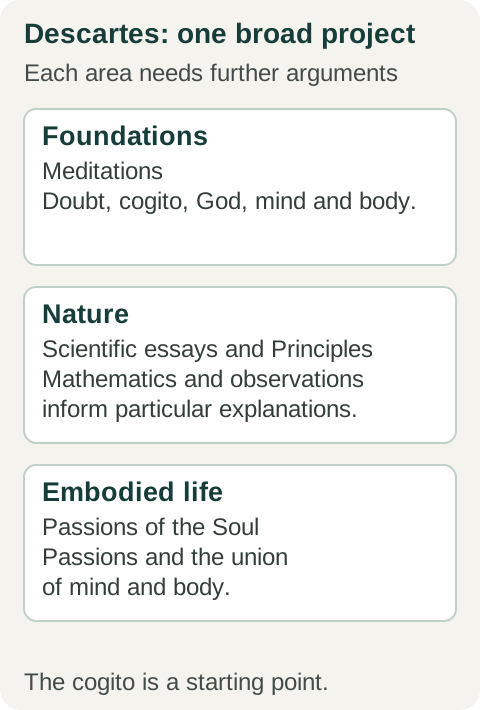
A helpful first reading separates three tasks: identifying what survives radical doubt, explaining what kinds of things exist, and investigating particular natural phenomena. A success in the first task is not automatically a success in the other two. Descartes supplies further arguments, and critics have challenged different parts of the project for different reasons.
Further reading: René Descartes
Methodical doubt is a test of foundations
In Meditation I, Descartes examines beliefs that can be doubted rather than beginning with a catalogue of things proved false. The senses sometimes mislead; dreams can resemble waking experience; a more radical deceiver hypothesis raises the possibility of error even in apparently straightforward judgments. These are stages of a method for finding what cannot be shaken.
The distinction between doubt and denial matters. If an experience might be a dream, it does not follow that it is a dream. Nor does considering deception establish that an actual deceiver exists. The hypotheses suspend a claimed basis for certainty while Descartes asks whether any proposition remains secure under the imagined conditions.
This method is demanding because its target is foundational certainty. It should not be confused with a recommendation that people abandon ordinary action until every belief is demonstrated. Descartes’ scientific work uses observations in investigating particular phenomena. The philosophical test asks what could serve as an ultimate ground; the scientific investigation asks which explanation fits the phenomena.
Further reading: René Descartes
What the cogito establishes, and what it leaves open
In the second Meditation, the act of doubting cannot remove the existence of the thinker while that act occurs. If I am being deceived, there must be something being deceived. The certainty is tied to thinking itself: an attempt to doubt the thinker’s existence performs the activity on which the certainty rests.
The Discourse expresses the point in the familiar form “I think, therefore I am.” The Meditations presents it through the certainty of “I am, I exist” when thought. These formulations have prompted discussion about the argument’s exact character. What matters for a first reading is that the existence claim survives the radical doubt that has suspended confidence in the body and external things.
At this stage, Descartes has not established that the thinker lacks a body. Knowing that thinking occurs while not yet knowing the nature of the body is a difference in what is known. A conclusion about whether mind and body are genuinely distinct requires more. Meditation II is therefore a starting point for the inquiry, not a shortcut around Meditation VI.
Further reading: René Descartes
A worked mistake: different descriptions need not mean different things
Imagine a student knows that the archive’s anonymous translator produced a particular translation, but does not know that the translator is Mara Ellis. It would be a mistake to conclude that the anonymous translator cannot be Mara. The student’s different knowledge of the two descriptions does not establish that they refer to different people.
This constructed example explains a danger in moving too quickly from an epistemic distinction to a metaphysical one. “I know this under one description and do not know it under another” can reflect incomplete information. It does not by itself demonstrate two separate entities. Descartes’ later arguments need to do more than repeat that thinking is known before the body is.
The example is not a refutation of every mind–body distinction. It identifies an insufficient argument for one. A careful reading asks whether Descartes supplies a positive account of mind and body and an additional reason they can exist separately. That is why the later discussion of clear and distinct understanding matters.
Further reading: René Descartes
Clear and distinct perception and the Cartesian circle
Descartes takes clear and distinct intellectual perception to have a special epistemic status. This is not simply a person feeling enthusiastic or confident. The project seeks an account of intellectual apprehension that can justify acceptance of a proposition. He connects the reliability of such perception with arguments for a God who does not deceive.
The famous circularity objection asks whether the argument relies on the very reliability it is supposed to secure. If clear and distinct perception is used to prove God, while God is needed to guarantee clear and distinct perception, the foundation appears to depend on itself. Antoine Arnauld raised this problem in the objections to the Meditations.
One important Cartesian response distinguishes what is perceived clearly at the present moment from confidence in a remembered demonstration. God’s guarantee is supposed to address the latter vulnerability. Whether this distinction adequately answers the objection remains debated. It should be presented as a response to assess, rather than as a universally accepted solution.
Further reading: René Descartes
The mind–body distinction requires a later argument
Descartes characterizes mind through thought and body through extension. Thought includes doubting, understanding, willing, imagining and sensing; it is broader than silently doing logical calculations. Extension concerns spatial magnitude and related features of matter. These descriptions provide different accounts of what mind and body essentially are.
In Meditation VI, the real-distinction argument connects a clear and distinct conception of mind apart from body, and body apart from mind, with their possible separation through divine power. Its premises and its account of clear and distinct conception are open to criticism. But it is a positive argument about the nature and separability of the two, not merely an inference from temporary ignorance of the body.
Descartes also distinguishes God’s independence from the dependence of created substances. Calling mind and body substances does not mean that they are self-sufficient in every respect. When a summary says “two substances,” ask which sense of dependence and which relation are being discussed. Otherwise a short label can obscure the architecture of the view.
Further reading: René Descartes
Elisabeth’s question: how can mind affect body?
Princess Elisabeth pressed Descartes on interaction: how can an unextended mind move an extended body? If bodily motion is explained mechanically, it is not obvious how an entity without the relevant spatial features can enter that explanation. Her question exposes a difficulty in combining the distinction of mind and body with their apparent causal interaction.
Descartes does not describe ordinary human life as a detached observer looking at a body from outside. Hunger, pain and emotions belong to his account of an intimate mind–body union. Establishing distinctness and explaining union are therefore related but different problems. A theory can insist on both while still owing an adequate account of their compatibility.
Do not treat the existence of two categories as an explanation of interaction. Nor does observing that thoughts and bodily changes accompany one another settle how interaction works. Elisabeth’s challenge remains useful because it asks the theory to explain a connection that its description of the two natures makes difficult.
Further reading: René Descartes
Descartes’ science was mathematical and empirical
The scientific essays published in 1637 show the practical reach of the project. Descartes worked on refraction and the rainbow, and linked geometrical methods with natural phenomena. His broader physics tried to explain nature through the sizes, shapes, positions and motions of matter, replacing the active forms of the older Aristotelian framework.
It would be misleading to describe this as deriving every scientific fact from the cogito. Particular explanations require attention to phenomena, observations and measurements. The relation between metaphysical principles and a specific physical hypothesis is not the same as the relation between the premise and conclusion of a short mathematical proof.
His account of vortices carrying planets and his explanations of magnetism were subsequently challenged, and Cartesian physics was largely abandoned during the eighteenth century. Historical significance does not make those mechanisms current science. Their importance lies partly in the ambition to explain terrestrial and celestial phenomena within a unified account, not in the continuing truth of every proposed detail.
Further reading: René Descartes
The passions show why the body cannot be omitted
The Passions of the Soul appeared in 1649, after a correspondence in which Elisabeth had raised questions about conduct, emotion and the union of mind and body. Descartes analyzes passions in connection with bodily processes. His six primitive passions are wonder, love, hatred, desire, joy and sadness; more complex passions are discussed through this framework.
The physiological explanation uses “animal spirits,” understood as fine material fluids in a historical mechanical account. The phrase does not refer to ghosts or modern clinical neuroscience. Descartes also describes many bodily activities occurring without deliberate mental intervention. These features complicate the caricature of a thinker who assumes every bodily movement results from conscious calculation.
The work belongs in a reading of Descartes because it addresses embodied experience rather than leaving the discussion at a disembodied cogito. Its mechanisms should be read historically, and its arguments about the mind–body relation philosophically. A useful question is how this account of passions fits the distinction of mind and body, rather than whether the title supplies a modern treatment for emotions.
Further reading: René Descartes
A reading route through the arguments
Start with Meditations I and II. Mark what is doubted, what is established, and what remains unresolved. For the wax discussion in Meditation II, distinguish changing sensory qualities from the understanding of the object through those changes. The separate worked guide below follows that passage in detail; it does not replace the broader sequence of the Meditations.
Next read the discussions of God, error and clear and distinct perception before Meditation VI. Write down the circularity objection beside Descartes’ response. When reaching the mind–body distinction, identify the positive premises instead of assuming it followed immediately from the cogito. The order makes the dependence between the arguments visible.
Finally compare the scientific essays or Principles with the Passions. Ask which claims supply foundations, which propose explanations of nature, and which concern embodied life. The objections are part of the reading, not an appendix to skip: they reveal exactly where a premise, inference or explanation is carrying more weight than a familiar slogan suggests.
Further reading: René Descartes · Rationalism vs. Empiricism
Check your reading
Does methodical doubt establish that the world is a dream?
No. A possibility introduced to test certainty is not thereby proved actual. Doubting a claimed ground and denying the belief are different acts.
Does the cogito by itself prove an immaterial mind?
No. It establishes the thinker’s existence while thinking. Descartes supplies a further argument for mind–body distinctness in Meditation VI.
What makes the Cartesian circle an objection?
The objection asks whether clear and distinct perception is used to establish God while God is used to guarantee that perception. Descartes’ present-versus-remembered perception response is one point at which to evaluate the argument.
Did Descartes reject all scientific observation?
No. His scientific investigations address observed phenomena and particular hypotheses. Foundational metaphysical certainty and the evidence for a physical explanation perform different tasks.
Does mind–body dualism explain interaction automatically?
No. Elisabeth asks how an unextended mind can affect an extended body. Stating that the two are distinct does not yet answer that causal question.
Sources and further reading
References checked on 2 November 2026. The bell, archive, arithmetic and lending examples are constructed for explanation.
- Rationalism vs. Empiricism
Stanford Encyclopedia of Philosophy
Used for domain-specific classifications, intuition and deduction, and selected discussions of innate knowledge and concepts. These are competing theses, rather than a single commitment shared by every rationalist.
- René Descartes
Stanford Encyclopedia of Philosophy
Used for the works listed here and the discussions of metaphysics, mechanistic science and passions. Its account distinguishes the cogito from later arguments about the mind and body.