Practical guide
Hume's Missing Shade of Blue: What Exactly Is the Exception?
The exception is a very specific one: a person with extensive color experience might form the idea of a particular shade never previously seen. Hume is not imagining someone with no experience of color inventing it from nothing. The passage challenges an unrestricted claim that every simple idea must copy a corresponding prior impression.
Locate the claim before judging the exception
In section II, “Of the Origin of Ideas,” of An Enquiry Concerning Human Understanding, Hume distinguishes the comparatively lively perceptions he calls impressions from the less lively perceptions he calls thoughts or ideas. He argues that ideas depend on prior impressions. The missing shade appears inside that discussion, immediately after his support for the principle—not inside the later argument about induction.
The proposed counterexample concerns a corresponding impression of one particular shade. It does not remove the person's experience of neighboring shades or of color generally. Keep those two facts together: the exact shade is missing, but the relevant background experience is extensive.
Reconstruct the thought experiment in five steps
- A person has enjoyed sight for thirty years and encountered colors of many kinds.
- There is one particular shade of blue the person has never encountered.
- Other shades of blue are placed before the person in an ordered progression from darkest to lightest, with that shade omitted.
- The person notices a larger gap between the two colors around the missing position.
- Hume asks whether imagination could supply the idea of the absent shade despite the absence of its corresponding previous impression. His answer is that few people would doubt this ability.
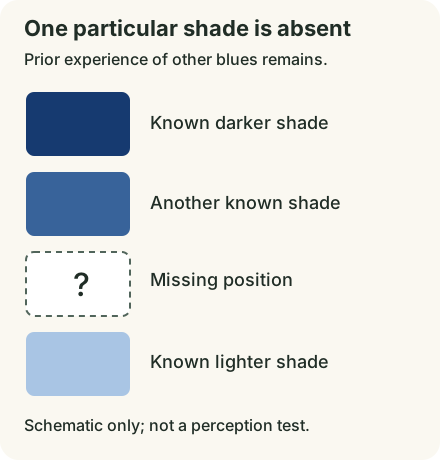
“Not previously seen” is the crucial condition. If someone first shows the person the omitted shade and then asks for a memory of it, the relevant impression is no longer missing. The exercise would have changed the premise that gives the example its force.
What does the example put under pressure?
For this reading, state the strict claim under examination as: every simple idea has a corresponding earlier impression from which it is copied. A counterexample would need an idea that meets the relevant description while lacking that corresponding earlier impression. Hume offers the missing shade as such a case.
Do not replace the strict claim with “experience is often useful” or “people need some experience to think about colors.” Those weaker claims can remain true in the thought experiment. A person can rely on prior experience of other shades while lacking experience of this one. That is exactly why the example is more subtle than imagining an entirely new sensory faculty.
Nor is the example the ordinary construction of a complex idea from familiar parts, such as combining the ideas of a familiar animal and a familiar wing. Hume has already allowed the mind to combine, transpose, enlarge and diminish materials supplied by experience. The difficulty here is whether the particular shade can be treated as a simple idea without its own corresponding impression.
Three cases that should not be confused
| Case | What experience is available? | What can this case show? |
|---|---|---|
| Remember a shade already seen | The particular shade has been experienced. | It fits the ordinary impression-to-idea account; it is not this counterexample. |
| Supply the omitted shade | Other shades are familiar; this particular shade has not been seen. | This is Hume's proposed limited exception to the unrestricted copying claim. |
| Invent color with no color experience | No relevant color experience is supplied. | Hume's missing-shade setup does not establish this ability. |
The table separates conceptual possibilities described by the text. It does not report a scientific experiment. A browser display, a paint-mixing task or a participant's self-report would need its own method before it could supply empirical evidence about perception.
Why does Hume keep the principle?
Hume explicitly acknowledges that the case could show that ideas are not always derived from corresponding impressions. He then calls the example sufficiently singular that it is not worth changing his general maxim for it. A careful answer should include both moves: the concession and the decision to retain the maxim.
That decision does not erase the logical difference between a universal statement with no exceptions and a useful general principle with a recognized exception. If the strict universal reading is the target, accepting even one genuine exception matters. If the question is whether experience still supplies the materials for most thinking, the same example is much less damaging. Specify the target before declaring that the passage either destroys or perfectly vindicates empiricism.
The Stanford Encyclopedia's Hume entry discusses the importance of gradation in the example and why the exception need not generalize to all uses of the copy principle. That is a scholarly explanation of its limited scope. It is not a license to attribute every later interpretation to Hume's own paragraph. In an essay, distinguish what Hume says, what an interpreter proposes and what you argue.
A short reading exercise with explained answers
For each claim, ask whether the missing-shade paragraph supports it.
1. “The person has never experienced any blue.”
No. The person is familiar with the other shades. Removing that experience changes the thought experiment.
2. “The idea may lack an impression of that very shade.”
Yes, as Hume's proposed exception. The exact corresponding shade is what has not been experienced. This is the pressure on the unrestricted copy claim.
3. “Hume reports a laboratory demonstration.”
No. He asks the reader to consider a hypothetical case and appeals to what people would judge possible. The passage is not a report of participants, measurements or a controlled procedure.
4. “Hume therefore abandons all dependence on experience.”
No. He retains the general maxim, and the person in the example still has extensive relevant experience. That broad conclusion does not follow from this case.
Write an answer that keeps the qualification
A compact answer can use this structure: Hume asks whether a sighted person, familiar with other shades of blue but lacking one particular shade, could supply the idea of that omitted shade. If so, that idea would lack its own corresponding prior impression. Hume recognizes this as an exception but considers it too singular to require abandoning his general maxim.
Then add your judgment. For example, ask whether the general maxim is intended as an exceptionless thesis or a broadly useful account of the mind. Explain why that distinction changes how serious the concession is. Quoting the word “singular” without identifying the proposition at issue does not finish the argument.
For the separate problem of moving from past observations to future expectations, read Hume's problem of induction. To distinguish the source of concepts and knowledge across different domains, continue to empiricism and rationalism. These are related questions, each with its own argument.
Sources and further reading
- David Hume — An Enquiry Concerning Human Understanding, section IIPrimary paragraph containing the missing shade, the prior-experience setup, Hume’s question and his concession. This guide paraphrases the argument rather than reproducing a long passage.
- Stanford Encyclopedia of Philosophy — David HumeThe account of the copy principle, missing shade and gradation in the philosophy-of-mind discussion. This contextual interpretation is distinguished from the primary paragraph.