Scottish Enlightenment · 1711–1776
David Hume
David Hume (1711–1776) studied how human beings think, feel, judge and act. His questions about causation and induction are famous, but his project also includes the passions, moral character, social conventions and religion. He asks both what supports our beliefs and why we naturally form them. Those questions should be kept separate: explaining an expectation is not the same as demonstrating that it must be correct.
Updated
Major works: choose the question first
| Work and publication | What to read it for | A useful caution |
|---|---|---|
| A Treatise of Human Nature — Books I–II, 1739; Book III, 1740 | The understanding, passions and morals as a broad science of human nature. | It contains difficulties and arguments that the later Enquiries do not simply reproduce. |
| Essays, Moral and Political — 1741–1742 | Moral, political and social questions beyond the best-known epistemological arguments. | Hume’s career was wider than the problem of induction. |
| Enquiry concerning Human Understanding — 1748 | Ideas, reasoning about fact, causation, liberty, miracles and skepticism. | First published as Philosophical Essays concerning Human Understanding; renamed in 1758. |
| Enquiry concerning the Principles of Morals — 1751 | Virtue, approval, utility and the sentiment of humanity. | Compare its arguments with Treatise Book III rather than assuming complete identity. |
| The History of England — six volumes, 1754–1762 | Hume’s work as a historian. | His historical writing is another major part of his reputation. |
| Dialogues concerning Natural Religion — 1779, posthumous | Design arguments, divine attributes and the limits of religious inference. | The characters’ speeches cannot all be treated as direct statements by Hume. |
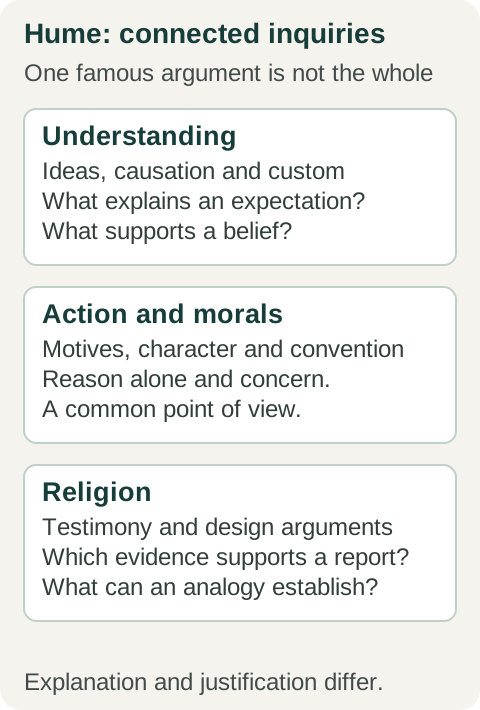
A science of human nature, not only a skeptical slogan
Hume was a Scottish Enlightenment philosopher, essayist and historian. The Treatise attempts an extensive account of human nature through the understanding, passions and morals. His naturalistic approach asks how familiar mental processes work, even when philosophical examination reveals that some of their supposed justifications are difficult to provide.
The distinction between explanation and justification is central. A psychological account can explain why someone expects a familiar event without proving the expectation true. Conversely, identifying a gap in a philosophical justification does not show that the mind can or should stop using the process. Hume investigates the practices that continue when an abstract demand for proof runs out.
His later Enquiries revise the presentation and, at some points, the arguments of the Treatise. Scholars disagree about how extensive those changes are. It is therefore useful to specify the work being read. Calling the Enquiries a short copy of the Treatise, or saying that Hume abandoned everything in it, hides important textual differences.
Further reading: David Hume
Impressions and ideas: a bell and its remembered sound
Imagine hearing a small brass bell and later recalling its sound. The immediate auditory experience illustrates an impression; the later recollection illustrates an idea. Hume distinguishes impressions and ideas partly through their relative force and vivacity. The distinction is not simply between things outside the mind and things inside it: both belong to the account of perception.
The copying principle concerns simple ideas and their relation to corresponding impressions. It should not be applied as though every complex imagined object must have been experienced as a whole. Someone can combine familiar elements to imagine a silver tree without having seen that tree. Composition is a different issue from the origin of the simple materials being combined.
Hume also considers the missing shade of blue: a person familiar with neighboring shades might imagine an omitted shade. This is an acknowledged difficulty for a strict generalization, rather than a license to invent any possible idea independently of experience. Read the example beside the copying principle to see both the ambition of the account and a complication Hume himself recognizes.
Further reading: David Hume
Relations of ideas and matters of fact
Hume distinguishes relations of ideas from matters of fact. Demonstrative reasoning about relations of ideas concerns results whose denial produces a contradiction in the relevant reasoning. Matters of fact concern how the world actually is; their opposites can be conceived without that kind of contradiction. The distinction is often called Hume’s fork.
For a constructed example, define a quarter-hour as fifteen minutes. Two quarter-hours are thirty minutes by that stipulated relation and arithmetic. Whether the bell actually rang twice during the last half hour is a different question. Understanding the definitions cannot establish what happened in the room; one needs observation, records or other relevant evidence.
The fork is a philosophical framework to evaluate, not an uncontested final classification of every possible truth. Its lasting usefulness is that it prevents a shift from a relation among ideas to an unsupported assertion about events. When reading an argument, ask whether its conclusion concerns a defined relationship or the actual occurrence of something in the world.
Further reading: David Hume
Causation involves more than noticing a repeated pair
Suppose a person repeatedly hears the bell just before the archive opens. The repetition can generate an expectation of opening after the next bell. What has been observed is a pattern of events. The further idea that one event necessitates the other requires explanation. Hume investigates how the mind moves from observed regularities to an expectation and an idea of necessary connection.
His discussion associates the idea with customary mental transition as well as regular conjunctions in experience. This is why “Hume says causation is just correlation” is too quick. It omits the psychological dimension of expectation and the interpretive dispute about whether his account excludes, leaves open or accepts connections beyond what we can directly observe.
Different interpretations give different weight to those elements. A first reading should identify the observed pattern, the expectation it produces and the claim about connection. Keeping them distinct allows the question to be assessed without silently turning a psychological explanation into proof of an objective necessity.
Further reading: David Hume
Induction: a gap in proof and an account of expectation
A past regularity is not logically identical to a future one. The archive may have opened after every observed bell and still remain closed next time. The conclusion about an unobserved event therefore is not a demonstrative consequence of the observed cases alone. That does not mean the observation has no practical relevance; it identifies the kind of support that needs discussion.
Hume’s challenge asks what supports the transition beyond experience. Appealing to the past success of that transition can already rely on a further transition from past cases to unobserved ones. The separate induction guide below reconstructs this problem in detail. This profile places it within the broader project, rather than treating that argument as the whole of Hume’s philosophy.
Custom explains the formation of expectations, but explanation and normative assessment should not be collapsed. Scholars debate the skeptical and constructive aspects of the account. Hume’s mitigated skepticism in the Enquiry also differs from an assertion that every ordinary judgment is worthless or that human life should come to a halt.
Further reading: David Hume
The bundle account does not mean that nobody exists
When Hume examines what is encountered in introspection, he finds particular perceptions rather than a separately observed, unchanging self. His account of personal identity examines how a succession of perceptions comes to be regarded as a persisting person. The question concerns the grounds and character of that identity, not whether people ever think or act.
Return to the bell example: a heard sound, a remembered sound, a feeling of expectation and a later disappointment are different perceptions. A bundle account asks what makes us regard the changing succession as one person’s experience. Simply identifying change does not by itself explain the relation between the successive perceptions.
Hume acknowledges serious difficulties in the Treatise Appendix. Interpretations differ about precisely what troubles the account and how to understand its components. A careful summary should preserve that uncertainty. “Hume proved there is no self” overstates what a contested analysis and its acknowledged difficulty establish.
Further reading: David Hume
Free will: compare constraint with causation
Hume’s compatibilist account connects liberty with acting according to one’s will, while necessity concerns regularity and inference involving character, motives and action. On this approach, an action need not be wholly uncaused in order to be free. The relevant contrast is not automatically between any cause and no cause at all.
Imagine a visitor decides to leave the archive because she wants to catch a train. Her preference and her understanding of the timetable help explain the action. Contrast this with a visitor locked in the archive and prevented from leaving. Both situations have causes, but the second introduces a constraint that the first does not.
This example illustrates the proposed distinction rather than resolving every dispute about responsibility. A critic may ask whether acting from one’s will is enough when that will has a causal history. Hume’s contribution is to make us state what liberty and necessity mean before assuming that they contradict one another in every sense.
Further reading: David Hume
Reason alone and the passions: why calm concern still matters
Hume argues that reason alone does not motivate action in the relevant sense. Reasoning can identify a relationship or inform us about consequences, but an end or concern is needed to move us. That is a narrower claim than saying reason never influences what anyone does. Correct information can change action when it interacts with a motive.
A visitor who wants to reach the train can reason about which route is quickest. If she learns that one exit is closed, her action may change. The reasoning matters because she has an end. The example separates information about means from the concern that gives the information practical significance.
Passion here does not mean only a sudden violent emotion. Hume distinguishes calm motives, including longer-term concerns, from more turbulent feelings. A calm concern for future well-being can be mistaken for the operation of reason alone. Reducing his view to “always obey an impulse” therefore loses an important part of the account.
Further reading: David Hume
Moral sentiment is not whatever an individual happens to like
Hume connects moral approval and disapproval with sentiment and evaluates qualities of character. Yet the account is not simply that every private pleasure makes its object virtuous. In the Treatise, sympathy helps explain responses to the people affected by a character, while a general or common point of view corrects distortions caused by our particular situation.
Suppose the archive manager is generous to a close friend but routinely careless toward other visitors. A judgment based only on the friend’s pleasure overlooks the wider pattern and those affected by it. Hume’s account asks us to consider character from a more stable viewpoint, rather than treating personal closeness as a sufficient standard of approval.
The second Enquiry emphasizes the sentiment of humanity and qualities useful or agreeable to oneself or others. Scholars debate how this account relates to the Treatise and how normative or descriptive the project is. Utility matters, but reducing the whole theory to a single calculation of consequences omits its attention to character and immediately agreeable qualities.
Further reading: David Hume
Justice and convention: why a shared rule matters
Hume distinguishes natural virtues from artificial virtues in the Treatise. Here “artificial” concerns human convention or artifice, rather than a claim that the virtue is fake. Justice raises a special question because the benefits of a system of rules do not always coincide with the immediate benefit of each separate act.
Consider a constructed lending arrangement among people sharing a small collection of books. If each borrower returns a book only when keeping it would not be convenient, the arrangement becomes unreliable. Stable expectations about returning books can support a shared practice even when one particular return is inconvenient. This illustrates the difference between assessing a rule-governed practice and an isolated immediate advantage.
Hume does not make the origin of convention depend on a promise that already presupposes the conventions being explained. He describes coordination developing through practice. His account of the precise motive to just action remains debated, and the second Enquiry treats justice differently in significant respects. The example illustrates the problem; it is not a complete derivation of every obligation from convenience.
Further reading: David Hume
Religion: testimony, explanation and the Dialogues
In the Enquiry’s discussion of miracles, Hume examines testimony in relation to experience and counterevidence. Questions include witness credibility, conflicting accounts and what kind of evidence would justify acceptance of the reported event. The argument is not well represented by “anything unusual is impossible” or by assigning a final probability of zero to every exceptional report.
His Natural History of Religion considers psychological and historical explanations of religious belief. That explanatory question differs from whether a religious proposition has an adequate rational foundation. Its speculative account and its intended philosophical implications are themselves subjects of interpretation. Explaining why a belief arises does not alone settle whether it is true.
The Dialogues presents arguments through Cleanthes, Demea and Philo, with Pamphilus narrating. Cleanthes defends design reasoning; Philo challenges the analogy between human artifacts and the world and what it could establish about a creator’s attributes. The work also raises questions about Philo’s concluding concessions. Read the exchanges before equating a single speech or character with Hume’s final position.
Further reading: David Hume
A reading route matched to the question
For knowledge and causation, begin with the Enquiry concerning Human Understanding, especially its discussions of the origin of ideas, skeptical doubts about reasoning and the response through custom. Then read liberty and necessity, miracles and the final discussion of skepticism. Track the difference between describing a belief-forming process and defending its authority.
For moral philosophy, read the Enquiry concerning the Principles of Morals beside the Treatise’s account of sentiment and justice. Ask what is evaluated, how approval arises, and why a common viewpoint or a system of rules matters. Do not assume that the slogan about reason alone answers all three questions.
For religion, choose a single exchange in the Dialogues and identify each speaker’s argument, the analogy being used and the limits of its proposed conclusion. Hume’s profile then becomes a set of connected inquiries into understanding, action and belief. The related pages below let you follow one inquiry further without compressing all of them into the problem of induction.
Further reading: David Hume
Check your reading
Must every imagined complex object have been seen as a whole?
No. Hume’s copying principle concerns simple ideas. Familiar elements can be combined into a complex idea, while the origin of the simple elements remains a separate question.
Does explaining an expectation through custom prove the next event?
No. A psychological explanation of expectation is different from a demonstration that the unobserved event must occur. Hume investigates both the gap and the natural process.
Does Hume mean that reason has no influence on action?
No. His claim concerns reason alone as a source of motivation. Reasoning about means and consequences can affect action together with an end, desire or concern.
Does any private pleasure make its object morally virtuous?
No. Hume’s account includes sympathy, a corrected or common viewpoint and attention to those affected by a character. It is not an unrestricted endorsement of personal liking.
Can Philo’s speech simply be quoted as Hume’s settled position?
That is unsafe. The Dialogues uses multiple characters, and the relation of their speeches and Philo’s concluding concessions to Hume’s own commitments is debated.
Sources and further reading
References checked on 2 November 2026. The bell, archive, arithmetic and lending examples are constructed for explanation.
- David Hume
Stanford Encyclopedia of Philosophy
Used for life and works, the understanding, motivation, ethics and religion. The entry presents competing interpretations of causation, moral sentiment and the Dialogues; the summaries here preserve those disagreements.