Practical guide
Hume's Problem of Induction: A Worked Reading Guide
Hume’s problem asks what justifies extending observed patterns to unobserved cases. Pure demonstration cannot rule out a different outcome, while using past success to justify the extension risks circularity. Reconstruct the dilemma and compare the kinds of answer offered by custom, probability and later responses.
What is Hume’s problem of induction?
Hume asks what supports the step from what we have observed to what we have not observed. Bread of a particular appearance has nourished us before; we expect another similar piece to nourish us. The expectation goes beyond the recorded cases. Why should the pattern extend to this new case?
In Section IV of An Enquiry concerning Human Understanding, Hume tests two kinds of answer. A demonstration from reason alone cannot establish that nature must continue in the same way: a different course is conceivable without contradiction. An argument from past experience appears to assume the very projection it is supposed to justify. Saying that experience has been reliable before still leaves the question of why its past reliability supports an unobserved outcome.
Section V then explains how we actually acquire these expectations: custom or habit carries the mind from a familiar observation to a belief about its usual companion. Keep the explanatory question and the justificatory question distinct. An account of why a belief occurs is not automatically a proof that its content will be true.
The problem is broader than forecasting tomorrow. It also concerns extending observations to other objects, places or times outside the evidence we possess. Nor is it simply the discovery that predictions sometimes fail. Hume asks about the foundation of the inference even when the observations have been accurate and the pattern has been exceptionally regular.
A passage-by-passage route through Sections IV and V
Use the Hume Texts Online version of Section IV, which displays paragraph labels such as E 4.16. Those labels make it possible to check a claim without relying on a page number from a different edition. Read the complete section once, then revisit the following turning points.
- E 4.1–2: Hume separates relations of ideas from matters of fact. The opposite of a matter of fact can be conceived without contradiction. His sunrise example establishes this contrast; it does not supply a weather forecast.
- E 4.4–6: He asks how we reach beyond present sensation and memory through causal inference. Knowledge of causal connections, he argues, comes from experience rather than inspection of an unfamiliar object alone.
- E 4.14–16: The question shifts. Saying “experience” does not finish the inquiry: what grounds the conclusions we draw from experience? His two bread statements separate a past record from a projection.
- E 4.18–19: The dilemma appears. Pure demonstration cannot exclude a change in nature; probable reasoning appeals to experience and seems to rely on resemblance between observed and unobserved cases.
- E 4.20–23: Hume distinguishes ordinary reliance on experience from the philosophical demand to explain that reliance. His discussion of children and animals also presses the claim that elaborate reasoning is not what originally produces familiar expectations.
Next read Section V, Part I, E 5.1–9. In E 5.5–8, custom explains the transition to belief. Notice that “sceptical solution” is the title of this next section. It should not be silently converted into a universally accepted mathematical proof of induction.
Reconstruct the argument without skipping the bridge
Start with two statements that do different jobs. “Every observed A has been B” reports the evidence. “The next A will be B” projects beyond it. The second statement is not another way to say the first. It adds an unobserved instance.
A useful classroom reconstruction then has six steps. This is an explanatory reconstruction, not a quotation or the only possible historical interpretation of Hume.
- Our recorded A-cases have been accompanied by B.
- We expect a new A-case to be accompanied by B.
- The transition requires some ground for carrying the observed pattern beyond those particular cases.
- Reason alone does not make a different outcome contradictory. Thus a purely demonstrative proof does not establish the projection.
- If we appeal to experience to justify the projection, that appeal itself carries a past pattern into an unobserved case. The proposed justification seems to depend on the same kind of transition.
- The requested foundation has not been supplied by either route. We still need an account of our inference and, depending on the interpretation, its justification.
Modern discussions often call the relevant resemblance assumption a uniformity principle. Avoid making it stronger than your example needs. A commuter need not assume that every event in the universe repeats exactly; the immediate assumption concerns whether earlier journeys bear on the next journey under relevantly similar conditions.
The deeper challenge nevertheless returns when you ask why those selected similarities should be predictive. Naming the bridge makes the inference easier to inspect. It does not, by itself, establish the bridge’s reliability. Some philosophers also formulate the problem without requiring one universal uniformity premise; the question can be directed at a particular observed-to-unobserved transition.
An original map of the two proposed routes
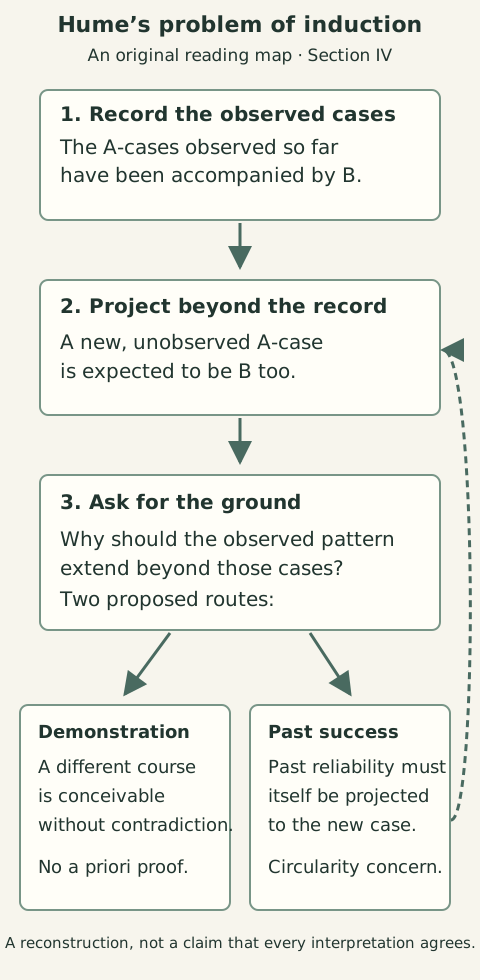
Read the return arrow carefully. The complaint is not that we are prohibited from considering past successes. Past performance often matters when choosing between particular methods. The concern arises when we use a past record to provide a foundational justification of the very practice of projecting past records.
To test your reconstruction, replace A and B with concrete terms. Then underline the sentence that concerns something outside the record. If every sentence describes only observed cases, you have not yet written the prediction. If a general rule appears among the premises, ask separately what supports that rule.
Why the two horns are more than “deduction versus induction”
Hume’s “demonstrative” reasoning concerns relations of ideas and the exclusion of contradiction. It should not be treated as a simple synonym for every argument that modern logic calls deductively valid. A valid deduction can have contingent premises and a contingent conclusion: if all the library’s books are catalogued and this is one of its books, the conclusion follows, but the first premise could be false.
Putting “nature will continue in the relevant way” into a premise can therefore make a subsequent inference deductively valid. That does not establish the premise. This distinction prevents an easy but misleading answer: write the desired regularity into the argument, apply a valid rule and declare Hume refuted.
The second horn also concerns more than probability below one. Hume writes that experimental conclusions proceed on the supposition that the future will be conformable to the past
(E 4.19). Merely changing “must happen” to “probably happens” does not explain why the probability assignment is supported. A probabilistic answer must expose its assumptions and show what kind of justification it offers.
Scholars dispute the scope of Hume’s conclusion. Is he principally explaining the cognitive process, rejecting a particular rational foundation, or presenting a broader skeptical challenge to justification? The Stanford entry’s reconstruction discusses these alternatives. Preserve that distinction before attributing to Hume the sweeping claim that no ordinary belief can be rational.
Three everyday cases: identify exactly what is being extended
A familiar journey
Suppose a bus arrived before your appointment on six observed Monday mornings. You expect it to do so next Monday. Your evidence concerns those six journeys; your expectation concerns a seventh. The bridge includes the thought that the recorded conditions remain informative about the next trip.
You can improve this particular expectation by checking the timetable, roadworks and whether the earlier Mondays were typical. Such checks distinguish a careless inference from a more informed one. They do not convert the six arrivals into a proof that the seventh arrival must occur, or provide a general non-circular foundation for using experience.
A file-export routine
A program exported ten test files correctly, so a team expects it to export the next file correctly. A new file may include characters or sizes absent from the tests. This exposes a practical sampling problem: the cases tested may not cover the new case’s relevant features.
Now suppose the team greatly improves coverage and repeats tests under varied conditions. That responds to the sampling objection. Hume’s further question still asks what supports extending the observed success to another case. Keep the two levels separate: a known gap in a test set is repairable in a particular way; the general foundation problem is not removed simply by adding more rows.
A general rule and one instance
A student writes, “Every token in this collection has a barcode; this token belongs to the collection; therefore it has a barcode.” The conclusion follows deductively from the premises. The next question is where the universal premise came from. Was the collection completely inspected, was a rule stipulated for a formal exercise, or was the claim inferred from a sample?
If it came from a sample, the final deduction does not erase the earlier inductive step. If it came from complete inspection of a fixed collection, the evidence has a different scope. You cannot transfer that complete-collection result to future additions without checking what the claim originally covered.
A worked probability example: six heads, two different models
The following coin records are hypothetical teaching data. Imagine six observed tosses, all heads. Compare two explicitly different setups. The same short record does not determine a unique next-toss probability without a model.
| Setup | Six-head record | Next-head probability | Why |
|---|---|---|---|
| Known fair coin; tosses independent | Possible, though unusual. | 1/2 = 50% | The next toss remains governed by the known fair independent model. |
| Unknown fixed head probability; tosses conditionally independent; uniform prior on that probability | Evidence changes beliefs about the unknown bias. | 7/8 = 87.5% | The uniform-prior rule of succession gives (heads + 1)/(tosses + 2). |
| No specified stable process, prior or probability model | A record by itself. | No unique numerical answer supplied. | The assumptions needed for either calculation have not been established. |
For the second row, substitute six heads and six tosses into the rule: (6 + 1)/(6 + 2) = 7/8. This is an illustration of the Bayes–Laplace model discussed in the Stanford entry, not a measured probability for an actual coin you own. The uniform prior, a stable parameter and the conditional sampling assumptions matter.
The first row also shows why a run of heads does not make tails “due” under a known fair independent model. The second row is not that model: uncertainty about the bias makes the previous results informative. Confusing the rows creates an apparent contradiction where the premises actually differ.
Probability theory provides precise conditional reasoning. The philosophical question concerns the grounds for the model, the prior and its application to unobserved cases. Bayesian reasoning makes those choices inspectable; claiming that the formula alone forces every real process to keep behaving regularly would go beyond the calculation.
What does custom explain in Section V?
Hume imagines a newcomer to the world who observes one event followed by another. One sequence alone does not reveal a hidden causal power. With repeated conjunctions, however, the observer comes to expect one event when the other appears. Hume calls the tendency custom or habit.
“Habit” here is not just a bad personal routine or deliberate rote memorization. It names the mind’s propensity to make a transition after repeated experience. In E 5.5, Hume explicitly says that naming this principle does not pretend to give the ultimate cause of the propensity. The word identifies an operation by its effects rather than explaining every detail of its mechanism.
This account answers an important question: why do ordinary expectations continue even when a philosophical demonstration is unavailable? In E 5.2, Hume says that the discovery of the missing argumentative step does not destroy the reasonings of common life. A person can examine the foundation of an expectation while continuing to rely on experience.
That does not mean every habitual expectation is equally well supported. Careful observation, attention to contrary cases and distinctions between circumstances still matter. Nor does the explanatory account by itself settle every modern question about rational warrant. When reading Section V, label what explains the formation of belief, what describes its role in action, and what would establish its reliability. Those are connected tasks, but a passage addressing one need not have completed all three.
Compare the kinds of answer different responses offer
A response can dispute a premise, reinterpret the demand for justification or accept a limit while defending a weaker goal. Asking what job an answer performs is more useful than declaring that one short slogan “solves Hume.” The later positions below are summaries of the selected Stanford sections, rather than independent readings of all the named philosophers’ works.
| Response | Main move | What to examine next |
|---|---|---|
| Hume: custom or habit | Explains the natural transition from repeated experience to expectation. | Does this supply a normative justification, a cognitive explanation, or both under a particular interpretation? |
| Bayesian approach | Computes conditional probabilities using evidence, a model and prior assignments. | What supports the model and prior, and what scope does the resulting probability have? |
| Strawson: ordinary-language approach | Evaluates an inductive inference by ordinary inductive standards, such as varied supporting evidence. | Does following those standards also answer the question of likely future success? |
| Reichenbach: pragmatic vindication | Defends an inductive policy through a weaker goal of success if a suitable long-run regularity is available. | Which notion of success, time horizon and practical costs does the defense require? |
For Strawson, asking whether a particular inference meets reasonable evidential standards is meaningful. Demanding a further justification of those standards as a whole may misdescribe what “reasonable” means in that context. A critic can reply that conformity to customary standards and grounds for expecting a true conclusion are different questions.
Reichenbach’s argument concerns finding a limiting frequency if one exists. A guarantee of eventual approximation under that condition is not a guarantee that a short sequence supplies a safe or accurate immediate prediction. The Stanford discussion also raises costs of trying and the possibility of other convergent methods. A pragmatic defense should not be flattened into “use induction because it is our only option.”
None of these brief summaries warrants announcing that the debate is closed. To develop an objection, specify the proposed answer’s target first: true conclusion, probable conclusion, adherence to a norm, explanation of belief, or a defensible policy for action.
Eight original reading checks with explained answers
These exercises concern the structure and scope of an argument. They do not ask you merely to label a sentence deductive or inductive. Write the missing assumption or mistaken conclusion before opening the explanation.
Case 1
A file routine succeeded in ten observed cases. A writer treats “it will succeed in the next case” as another description of those ten cases. What changed?
Show answer and explanation for case 1
The second statement adds an unobserved case.
The record and the projection have different scope. Ten successes may support an expectation under suitable assumptions, but reporting them does not itself describe the eleventh outcome. State the bridge: the tested cases are thought to be informative about the next case in relevant respects. You can then investigate coverage and circumstances. Hume’s further question asks what grounds the general practice of extending an observed regularity. Adding the word “therefore” between the statements does not supply that ground.
Case 2
Someone argues: induction has produced accurate conclusions before, so that proves induction will remain reliable. Where does the circularity concern enter?
Show answer and explanation for case 2
Past success is being projected into unobserved success.
The premises report an earlier record, while the conclusion extends it. A foundational defense of that extension cannot simply assume that the earlier record carries over; this is the kind of transition whose ground is being requested. This does not show that track records are useless when comparing specific methods in practice. The task matters. Using a record for an ordinary conditional expectation and using it as a general non-circular justification of the practice are different claims.
Case 3
A study gathers a much larger and more varied sample. Has it thereby settled Hume’s foundation problem?
Show answer and explanation for case 3
It may improve the particular inference without settling the general problem.
A larger, more appropriate sample can address sampling error or omitted conditions. Those are real improvements, not philosophical irrelevancies. But the move from the observed sample to an unobserved case still needs some ground. Hume’s dilemma concerns that extension, even after we suppose the observations are accurate. Distinguish “better evidence for this conclusion” from “a general non-circular justification of extending evidence.” Otherwise you either overstate what better sampling proves or dismiss useful empirical improvements.
Case 4
Under the known fair independent coin model, six heads have occurred. Must the next toss be tails to balance the run?
Show answer and explanation for case 4
No. The model still assigns one half to heads on the next toss.
Independence means the previous results do not change the next-toss probability in this specified model. A particular six-head run can occur without creating an obligation for the next result to correct it. Long-run balance is not a schedule assigning compensating outcomes to individual tosses. This answer is conditional on the known fair independent setup. It should not be copied into the different problem of learning an unknown bias, nor used to claim that a real mechanism has been certified fair.
Case 5
With an unknown fixed head probability, a uniform prior and conditionally independent tosses, six heads give a next-head probability of 7/8. Is that a proof that the next toss will be heads?
Show answer and explanation for case 5
No. It is a conditional probability, and its assumptions matter.
The rule of succession produces (6 + 1)/(6 + 2), which is 7/8. Even under that model, tails retains positive probability. The calculation also does not establish the fixed-parameter assumption or the uniform prior for every possible real process. The example shows how a probabilistic framework can articulate evidence and assumptions. It cannot justify a stronger claim of certainty merely because the arithmetic is exact. A different model or prior can change the answer without changing the six recorded outcomes.
Case 6
A valid deduction uses “all future A-cases will be B” as a premise. Does the valid form itself establish that premise?
Show answer and explanation for case 6
No. Validity concerns what follows if the premises are true.
A deductive argument may validly deliver a contingent conclusion from contingent premises. Its form does not make those premises true or tell us how they were learned. If the universal claim was inferred from past cases, the question about that prior inference remains. This is why modern deductive validity should not be equated with Hume’s demonstrative establishment of a relation of ideas. Keep the premise’s evidential basis and the final inference’s form on separate lines in your notes.
Case 7
A person expects heat after repeated encounters with flame. Hume explains this through custom. Has explaining the belief’s occurrence already guaranteed its truth?
Show answer and explanation for case 7
No. Formation and truth are distinct questions.
The custom account identifies why the mind makes an expectation after repeated conjunctions. A belief can have an understandable origin without its content being guaranteed true. At the same time, calling custom the origin does not mean every expectation is arbitrary or that Hume tells us to abandon ordinary life. Different interpretations debate how his explanatory account connects to justification. A careful answer states which task the passage addresses and avoids turning a psychological explanation into either a universal proof or a universal condemnation.
Case 8
A policy is defended because it can eventually find a limiting frequency if one exists. A reader concludes that it guarantees tomorrow’s prediction at no practical cost. What was added?
Show answer and explanation for case 8
An immediate guarantee and a cost assumption were added.
A conditional long-run result does not automatically establish accuracy in a particular short run. The condition that a limiting frequency exists must also remain visible. Practical justification can depend on what happens if a prediction fails and on the costs of trying. Reichenbach’s pragmatic approach, as surveyed in the Stanford entry, should therefore be assessed by its actual goal and limitations. The reader’s stronger statement changes both the time horizon and the kind of justification offered.
Build a short study record you can revise
Choose an everyday expectation, then use the blank record below. Keep the observation and projection separate enough that another reader could disagree about the bridge without denying the observations. Finally identify the kind of answer you are proposing: an explanatory account, a probability conditional on assumptions, an evidential standard or a practical policy.
Observed cases and their limits:
Unobserved conclusion:
Relevant similarities or stability assumptions:
Proposed ground for the transition:
Does that ground itself project an observed pattern?
What kind of justification or explanation is being offered?
Possible objection / missing assumption:
Primary paragraph and secondary discussion checked:
Revised conclusion and remaining uncertainty:
Download the blank text study record. For an essay, make the objection specific. “Hume is skeptical” is a topic label; “the proposed empirical defense projects the very pattern whose extension is being questioned” identifies the argumentative difficulty. A strong revision also acknowledges the useful work that observation and conditional reasoning can still do.
Sources and further reading
- David Hume, Enquiry concerning Human Understanding, Section IV — Hume Texts OnlineComplete Section IV read. Paragraphs E4.14–23 ground the observed-to-unobserved distinction, demonstration and circularity argument. The eight-word quotation is from E4.19.
- David Hume, Enquiry concerning Human Understanding, Section V — Hume Texts OnlinePart I, E5.1–9, read in full. E5.2 and E5.5–8 ground the account of custom and the continuation of ordinary reasoning. The rest of Section V is not treated as fully reviewed.
- Stanford Encyclopedia of Philosophy: The Problem of InductionIntroduction and sections1–2, 3.3, 5.2 and 5.3 read. Supports reconstruction cautions, the conditional Bayes–Laplace example and ordinary-language and pragmatic response comparisons.