Practice worksheet
Necessary and Sufficient Conditions: Practice Problems with Answers
A sufficient condition guarantees the target under the stated rule; a necessary condition is required whenever the target holds. The direction matters: “P only if Q” makes Q necessary for P. Use the arrow guide and twelve original problems to test each direction, distinguish joint conditions and repair a faulty definition.
Necessary versus sufficient: start with the target
Ask “a condition for what?” before choosing a label. If A is sufficient for B, A guarantees B in the specified domain or model: A → B. If A is necessary for B, B cannot hold without A: B → A. Necessary does not mean enough, and sufficient does not mean the only route. Both labels describe a connection between two stated conditions, not an impressive or important property in isolation.
In the standard mathematical classification of quadrilaterals, being a square is sufficient for being a rectangle. Having four right angles is already included in the square definition. Being a rectangle is necessary for being a square, but a rectangle need not have four equal sides. A 2-by-5 rectangle separates the two directions. Keep the same target while you test them: when the target changes from rectangle to square, the labels change too.
The arrow reads “implies” in these exercises. It does not say that the condition causes the target, happens first, is desirable or actually occurred. When the rule is about every item in a domain, its guarantee applies to each item in that domain; one matching example is not a proof of the universal statement. A particular exception can disprove that guarantee, provided it really belongs to the domain and meets the relevant condition.
| Classification | Required guarantee | What can refute it |
|---|---|---|
| Sufficient | A → B | An A without B |
| Necessary | B → A | A B without A |
| Both | A → B and B → A | Either mismatch |
| Neither | Both guarantees fail | Show an A without B and a B without A |
For a both answer, explain each direction. For neither, provide a witness against each direction. “These things sometimes occur together” is not enough to settle either question. “I do not yet know” is also different from “neither”: it marks a gap in evidence rather than two established failures.
If, only if, and if and only if: an arrow guide
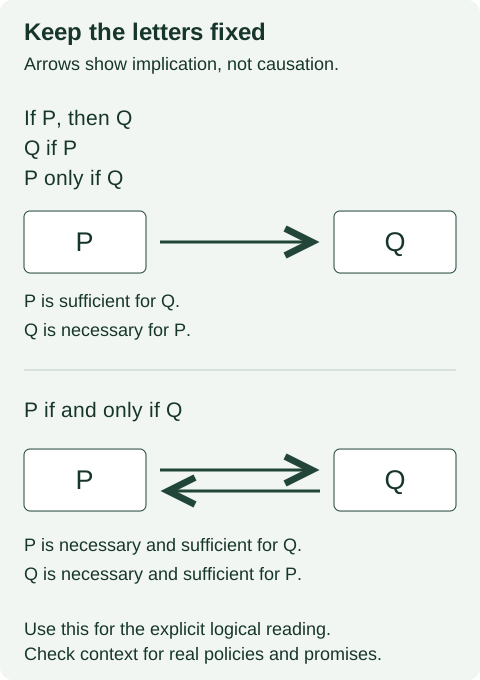
| Wording | Arrow | What the rule excludes |
|---|---|---|
| If P, then Q | P → Q | P true with Q false |
| Q if P | P → Q | P true with Q false |
| P only if Q | P → Q | P true with Q false |
| P is sufficient for Q | P → Q | P true with Q false |
| P is necessary for Q | Q → P | Q true with P false |
| P if and only if Q | P ↔ Q | Either one true while the other is false |
In “Q if P,” the condition comes after the word if: P → Q. Moving the clause within the sentence does not change its job. In “P only if Q,” the phrase after only if names what P requires: again P → Q. This is why memorizing “the phrase after if always goes on the left” fails when the phrase is only if.
Use a violation test when the wording feels slippery. “A file is released only if approved” is violated by a released file with no approval. It is not violated merely by an approved file awaiting release. “A file is released if approved,” under the classroom rule, is violated by approval without release. The same two nouns therefore produce different guarantees when their connecting words change.
If and only if, often shortened to iff, states both directions. P ↔ Q abbreviates P → Q together with Q → P. It does not mean “the relation is probably strong,” and it cannot be silently added to a one-way rule. Cases 7 and 8 let you compare the two sentences before combining them.
What the four truth-table rows do and do not show
For the explicit propositional interpretation here, the material conditional P → Q is false only when P is true and Q is false. A biconditional is true when its two statements have matching truth values. The table shows the truth function for one assignment at a time; a general claim about all objects or situations still needs the appropriate reasoning or evidence.
| P | Q | P → Q | P ↔ Q |
|---|---|---|---|
| True | True | True | True |
| True | False | False | False |
| False | True | True | False |
| False | False | True | True |
The third row is permitted by P → Q: Q may hold without P. It is the row to inspect when someone wrongly treats a sufficient condition as necessary. The second row is forbidden by P → Q. To disprove the guarantee, look for P without Q, rather than any situation in which P is absent.
The last two rows do not show that an absent trigger caused anything or that a real system has been tested. Material implication does not by itself encode causation, timing or relevance. A sentence about a promise, a mechanism or evidence can need a richer reading. The Stanford Encyclopedia of Philosophy discusses these limitations; the later context section explains how to keep them visible when leaving the worksheet.
Twelve practice problems with explained answers
All institutional rules, inventories and machine observations below are invented. Mathematical cases use their stated domains. For each question, keep the target fixed, write the arrow and give a reason or counterexample. Use classical propositional logic for the explicit rule translations; inclusive or allows both alternatives. Do not infer a causal mechanism or a real-world guarantee from a classroom stipulation.
Try the problem before opening its answer. Cases 1–5 classify properties or complete invented rules; cases 6–9 translate one-way, two-way and alternative conditions; cases 10–12 examine evidence, contraposition and a proposed definition. Where a condition is not guaranteed by the given rule, say that precisely rather than declaring that every possible stronger rule is false.
Download the twelve questions without answers · Download the explained answer key. Both files are plain text and can be printed or edited for personal study.
Case 1
Work with nondegenerate Euclidean quadrilaterals and the usual inclusive definition of rectangle. Let S mean square and R mean rectangle. Is being a square necessary, sufficient, both or neither for being a rectangle? Draw the arrow and supply a shape that tests the reverse direction.
Show answer and explanation for case 1
Sufficient, but not necessary: S → R. A rectangle need not be a square.
A square has four right angles, so every square meets the rectangle definition. A rectangle with side lengths 2 and 5 is a counterexample to R → S: it is a rectangle but its sides are not all equal. The counterexample does not challenge S → R. Do not use the everyday contrast “square versus rectangle” to exclude squares from rectangles after the question has explicitly chosen the inclusive mathematical definition. Relative to the same domain, being a rectangle is necessary for being a square. The two descriptions name the same one-way connection from different ends.
Case 2
Among integers, is being even necessary, sufficient, both or neither for being divisible by 4? Give an integer showing why the stronger classification fails. Distinguish “divisible by 4” from “equal to 4.”
Show answer and explanation for case 2
Necessary, but not sufficient. Divisible by 4 → even; even does not imply divisible by 4.
If an integer n is divisible by 4, n = 4k for some integer k. It is therefore 2 times the integer 2k, so it is even. The integer 6 is even but is not divisible by 4, disproving the reverse implication. The integer 8 also makes clear that the condition concerns divisibility, not equality to one number. This argument works for zero and negative integers as well: zero is divisible by 4, and −8 is divisible by 4 and even. No restriction to positive integers is needed for this particular result.
Case 3
For a fictional study room, admission A is permitted if and only if a person has a valid pass P and a booking B. No other entry route exists in this model. Classify P alone, B alone, and the conjunction P and B as conditions for A. Permission is the target, not whether someone actually walks through the door.
Show answer and explanation for case 3
P and B are each necessary but not sufficient. Together, P ∧ B is necessary and sufficient for A.
The exact rule is A ↔ (P ∧ B). A permitted entrant must satisfy both checks. A pass holder with no booking fails the full condition, and a booked person without a pass also fails. When both checks hold, the stated rule permits admission; no unstated third requirement is part of this model. Passing just one check does not finish the task. Conversely, “permitted” does not imply that the person chooses to enter. Keeping the target precise avoids converting an eligibility rule into a prediction about behavior. This rule is invented for the exercise and describes no actual institution.
Case 4
A fictional ten-question quiz gives an integer score from 0 to 10. Its complete rule says a pass means a score of at least 8, with no other requirement. Is scoring at least 8 necessary and sufficient for passing? Is scoring exactly 8 necessary? Is scoring exactly 8 sufficient?
Show answer and explanation for case 4
At least 8 is necessary and sufficient. Exactly 8 is sufficient, but not necessary.
Under the supplied definition, passing and having a score of 8, 9 or 10 coincide. Write Pass ↔ (score ≥ 8). A score of exactly 8 lies inside that range and therefore guarantees a pass, but scores of 9 and 10 are counterexamples to the claim that exactly 8 is required. The difference between “at least” and “exactly” changes the condition even though the numeral stays the same. No claim about a real exam, extra attendance requirements or rounding rules is being made. If a real course adds another requirement, its pass condition must be checked again rather than borrowed from this model.
Case 5
The complete fictional inventory contains four bicycles: a red working bicycle, a red broken bicycle, a blue working bicycle and a blue broken bicycle. Classify being red as a condition for being in working order, within this inventory. Identify a counterexample to each possible one-way guarantee.
Show answer and explanation for case 5
Neither necessary nor sufficient within the stated four-bicycle inventory.
The blue working bicycle disproves the claim that red is necessary for working order: the target occurs without red. The red broken bicycle disproves the claim that red is sufficient: red occurs without the target. Name both witnesses because one counterexample cannot do both jobs here. The working red bicycle shows overlap, which is entirely compatible with “neither.” The broken blue bicycle adds no guarantee. This is an exhaustive invented inventory, so the classification concerns these four bicycles. It does not describe manufacturing quality, all red bicycles or whether paint affects mechanical performance.
Case 6
A fictional processing rule says: “If a form is submitted, a receipt is issued.” Let S mean submitted and R mean receipt issued. Translate this stated rule. Which condition is sufficient for R, and which is necessary for S? Can receipt issuance alone establish submission?
Show answer and explanation for case 6
S → R. Submission is sufficient for receipt issuance; receipt issuance is necessary for submission under this rule. R alone does not establish S.
The conditional forbids a submitted form without a receipt. It does not forbid a receipt issued for another reason. A situation with R true and S false satisfies the stated one-way rule and defeats the proposed converse R → S. In this exercise, the rule is treated as a logical constraint over the relevant situations. We are not testing a real software service or using the truth table as evidence of reliable delivery. A receipt may be an effect of submission in a real system, but the displayed logical statement by itself neither supplies that mechanism nor proves that a particular submission occurred.
Case 7
An invented archive policy states: “A file is released only if it is approved.” Let L mean released and A mean approved. A draft translation says A → L. Correct it, name the required condition, and explain whether an approved but unreleased file violates the original sentence.
Show answer and explanation for case 7
The correction is L → A. Approval is necessary for release. An approved but unreleased file does not violate this one-way rule.
“Only if approved” attaches a requirement to release: no release without approval. It does not instruct the archive to release every approved file. The proposed A → L instead makes approval sufficient for release and forbids an approved file waiting in the queue, which is stronger than the given sentence. Under the original rule, a released and unapproved file is the forbidden case. An approved and unreleased file is allowed. Do not infer “approval is not sufficient in every real archive”; the narrower conclusion is that this sentence alone does not make it sufficient. Other policies could add the missing direction.
Case 8
Now the fictional rule is different: “A file is released if it is approved.” Use the same L and A as in case 7. Translate this sentence, compare it with “released only if approved,” and state what must be added to make approval necessary and sufficient for release.
Show answer and explanation for case 8
“Released if approved” is A → L. To get both directions, also require L → A, giving L ↔ A.
In the classroom reading, “L if A” reverses the order of the clauses: A is the sufficient condition for L. It does not rule out a release under another authorization route. “L only if A” instead rules out release without approval. Combining the two gives an exact equivalence between approval and release in the model. Do not replace “if” with “if and only if” merely because a real policy probably intended a complete procedure. Ask for clarification before strengthening a real requirement. This pair of cases changes the sentence rather than pretending that the two rules already said the same thing.
Case 9
A fictional indicator is lit I if and only if either switch R or switch B is on, or both are on. Classify R alone and the inclusive disjunction R or B as conditions for I. Compare this with the two-part admission rule in case 3.
Show answer and explanation for case 9
R alone is sufficient but not necessary. R ∨ B is necessary and sufficient for I.
The model is I ↔ (R ∨ B). Turning R on meets the stated condition, even if B is off. But with R off and B on, I is still lit, so R is not necessary. The whole disjunction is necessary because the indicator is not lit when both switches are off; it is sufficient because at least one on-switch makes the condition true. Inclusive “or” allows both switches to be on. In case 3, each component was required and neither alone sufficed. In this case, either component alone suffices and neither is required. The connector changes the answer; the number of named components does not.
Case 10
You have only three observations of a fictional machine. In two it is ready with its green light on; in one it is not ready with its green light off. Someone claims that a green light is necessary and sufficient for readiness in every future situation. What can these observations establish, and what remains unproved?
Show answer and explanation for case 10
Green and ready coincide in these three observations. The universal claim about all future situations is not established by this evidence.
Within the observed rows, neither mismatch occurs. But the supplied evidence leaves unobserved situations open: a green light with the machine not ready would refute sufficiency, and readiness with the light off would refute necessity. Proposing those possibilities does not mean either fault actually occurred. It identifies the evidence needed to test the guarantee. A complete, reliable specification might justify a stronger conclusion, while an additional contrary observation could disprove one direction. “Not established” describes an evidence limit, not a finding that the universal relation is false. Keep the scope of the answer at the scope of the information supplied.
Case 11
In a fictional record system: “A loan is closed only if its return is logged.” Let C mean loan closed and G mean return logged. Which follows: (a) if the return is not logged, the loan is not closed; (b) if the return is logged, the loan is closed; (c) if the loan is not closed, the return is not logged? Give a possible state that tests the unsupported options.
Show answer and explanation for case 11
Only (a) follows from C → G. It is ¬G → ¬C, the contrapositive. Options (b) and (c) require an extra direction.
A closed but unlogged loan would violate C → G. Consequently, lack of a log rules out closure when the rule is assumed true. A logged return with the loan still open satisfies the original rule but makes (b) false and (c) false. That one state has G true and C false. Notice that the contrapositive both reverses the arrow and negates both ends. Simply reversing the arrow gives the converse G → C, and simply negating both ends gives the inverse ¬C → ¬G. They are equivalent to each other, but neither is guaranteed by C → G alone.
Case 12
A classmate proposes: “Among positive integers greater than 1, a number is prime if and only if it is odd.” Test both directions separately. Use 2 and 9. Then give a correct defining condition for being prime in this domain.
Show answer and explanation for case 12
Oddness is neither necessary nor sufficient for primality. A prime has exactly two positive divisors: 1 and itself.
The number 2 is prime and is not odd, so it refutes Prime → Odd and defeats the necessity claim. The number 9 is odd but has positive divisors 1, 3 and 9, so it refutes Odd → Prime and defeats the sufficiency claim. A positive integer greater than 1 is prime exactly when its only positive divisors are 1 and itself. Naming 2 alone repairs neither direction: it diagnoses one failure. Naming 9 alone diagnoses the other. An “if and only if” definition requires both tests, even when one half seems plausible or agrees with several familiar examples.
Separate jointly sufficient conditions from alternatives
A checklist often contains several necessary requirements. Their conjunction may be sufficient if the complete rule explicitly says so, but listing requirements alone does not establish completeness. Suppose a real process requires a pass and a booking. That wording supports Admission → (Pass ∧ Booking). To infer (Pass ∧ Booking) → Admission, you also need confirmation that these checks are all that is required. Case 3 supplies that confirmation as a stipulation; real instructions may not.
With a complete conjunction rule, each component is necessary and the package is sufficient. A person can satisfy one part and still fail the package. This is the difference between “a necessary part of a sufficient condition” and “a sufficient condition by itself.” It helps when reading definitions, eligibility checklists and proposed explanations without treating every listed component as an independent guarantee.
An inclusive disjunction behaves differently. Under Indicator ↔ (R ∨ B), either switch alone suffices, while neither is individually necessary. The disjunction as a whole is necessary and sufficient. If the rule said exactly one switch, both-on would be excluded and the result would change. Write the connector rather than assuming what “two options” means.
These are properties of the displayed rule. They do not establish that a process is fair, that its conditions are physically achievable or that the target happens automatically when permission is granted. A clearer formula can reveal an ambiguity without answering those separate questions.
Check the converse, inverse and contrapositive separately
From P → Q, the contrapositive ¬Q → ¬P follows in classical logic. It forbids the same mismatch: P true while Q false. The converse Q → P forbids a different mismatch and needs separate support. The inverse ¬P → ¬Q likewise needs that extra support; it is equivalent to the converse under this interpretation.
Do not decide by how familiar the sentence sounds. Keep the letters fixed, preserve their negations and identify a possible assignment. A state with Q true and P false satisfies P → Q but defeats both the converse and inverse. Case 11 uses that exact check on a record-system rule.
If your next task is evaluating a whole argument, use the valid and sound arguments worksheet. The question there is whether all premises can be true while the conclusion is false, followed by a separate check of premise truth. This worksheet first clarifies what the condition itself says; neither exercise supplies evidence for a real policy merely by translating it.
Keep logical conditions separate from causes and evidence
Everyday conditionals may express a promise, an explanation, a temporal dependency or a reason for believing something. Rewriting them with a material arrow can omit those features. A confirmed outcome may provide evidence about an earlier event without causing that event. Conversely, a stated trigger can explain an outcome without proving that the trigger actually occurred in the case before you.
The standard necessary/sufficient translation is useful for the explicit inferential and definitional tasks on this page. It should not be presented as a complete theory of every English use of if. Before formalizing a real statement, identify its purpose, time reference, domain and exceptions. Ask whether the claim is a strict rule, a tendency, a promise or an incomplete description. Then state the interpretation you intend to test.
Evidence requires its own scope check. Three matching observations can establish that the observed rows match; they do not automatically establish every future case. A real specification may supply a guarantee, and an observed mismatch may refute one, but absent evidence should remain an open question. Case 10 demonstrates this distinction without inventing an actual failure.
For an essay or a requirements review, record four things: the exact target; the proposed condition and arrow; the stated domain or assumptions; and the proof, counterexample or missing evidence. If you repair a rule, label the new sentence as a revision. That keeps a useful improvement separate from what the original wording already warranted.
Sources and further reading
- Stanford Encyclopedia of Philosophy: Necessary and Sufficient ConditionsThe standard truth-functional account, necessary/sufficient reciprocity, only-if wording, and its limitations for ordinary-language dependencies. Sections 1–3 and the opening discussion of section 4 informed the explanation; the twelve cases and diagram are original.
- OpenStax, Introduction to Philosophy, section 5.3: ArgumentsSeparating logical analysis from truth analysis, premise/conclusion identification and conditional chains. The complete section was read; it does not verify any invented institution or machine here.