Logic and reasoning · An introduction
Logic
Logic studies relationships such as whether a conclusion follows from stated premises, whether claims are consistent and how proofs work. A useful introduction separates the words of an argument, their interpretation, the inference's form and the evidence for the premises.
Updated
A four-row test of a reversed conditional
| U: file uploaded | C: copy present | U implies C | Counterexample to: U implies C; C; therefore U? |
|---|---|---|---|
| True | True | True | No: the conclusion U is true. |
| True | False | False | No: the conditional premise is false. |
| False | True | True | Yes: both premises are true and U is false. |
| False | False | True | No: the second premise C is false. |
Identify the premises and conclusion
An argument offers statements as grounds for another statement. The grounds are premises; the supported statement is the conclusion. 'The file has been uploaded' is an assertion. 'Every uploaded file has a stored copy; this file was uploaded; therefore it has a stored copy' is an argument. Identifying those roles is the first step toward testing whether the conclusion follows.
The truth of a statement and the quality of an argument are different questions. A true assertion may be supported by poor reasoning, and a hypothetical argument may have a valid form without describing actual events. Logic gives tools for examining the connections. Evidence about a particular file, institution or event answers further questions about the premises.
Further reading: Timothy Shanahan, Internet Encyclopedia of Philosophy · Stanford Encyclopedia of Philosophy
Logical form makes the connection easier to inspect
Let U stand for 'this file was uploaded' and C for 'this file has a stored copy'. The argument 'if U, then C; U; therefore C' has the form called modus ponens. Its conclusion follows whenever its premises hold. Replacing the file story with different statements can leave that same pattern intact. The letters represent whole statements with fixed meanings, not a license to change the story halfway through.
Now consider 'if U, then C; C; therefore U'. The wording looks similar, but the inference is reversed. A copy might have been created through another route. That possibility is compatible with the stated conditional and the presence of a copy, while falsifying the claim that an upload occurred. The first premise gives a sufficient condition for C, not an exclusive history of how C could become true.
Further reading: Timothy Shanahan, Internet Encyclopedia of Philosophy · Stanford Encyclopedia of Philosophy
Read the counterexample row of the truth table
The table uses the classical material conditional: U implies C is false only when U is true and C false. It is not a report that a real storage system enforces a promise, nor does it establish that uploading causes every possible stored copy. The table examines a logical relationship under a specified interpretation of 'if'.
For the reversed argument, the premises are U implies C and C, and the conclusion is U. The third row makes U false and C true. Both premises are true there, yet the conclusion is false. One such row is enough to establish invalidity. The other rows do not need to be failures too.
Do not merely look for any false conclusion in a table. A row with false premises does not refute validity. The decisive combination is all premises true and the conclusion false. This distinction is what makes the table an argument test rather than a collection of unrelated true and false values.
Further reading: Stanford Encyclopedia of Philosophy · Timothy Shanahan, Internet Encyclopedia of Philosophy
Meaning and scope matter before formalization
Formal notation can expose a structure, but ordinary words may first need clarification. Suppose someone says that a package is in the hall or the office, that it is not in the office, and therefore that it is in the hall. The inference is valid under the stated either-or premise. If the package could instead be outside, that would challenge the premise's description of the possibilities, not that inferential pattern.
Likewise, 'all submitted projects were reviewed' differs from 'all reviewed projects were submitted'. One statement does not automatically imply the other. Keep the domain, category and direction fixed. If 'reviewed' changes from a quick automated check in one sentence to a complete evaluation in another, the same printed word no longer guarantees the same meaning.
This is why translating an ordinary argument is an interpretive task. Identify what the claims actually say before choosing the formal pattern. A technically correct calculation about the wrong representation may fail to answer the original question.
Further reading: Stanford Encyclopedia of Philosophy
Proof and models ask related but different questions
A deductive system supplies rules for deriving statements. A proof records licensed steps from premises or assumptions to a conclusion. A semantics supplies interpretations for the language. In model-theoretic evaluation, validity means that every interpretation satisfying the premises also satisfies the conclusion. A countermodel is an interpretation in which the premises hold but the conclusion does not.
The SEP presents classical first-order logic using a language, a deductive system and a semantics, then relates them through soundness and completeness. Those relationships are results about a specified system. They do not mean that every ordinary argument written with arrows is correct. The chosen formalization, rules and interpretation still matter.
Logical consistency is another question. A group of claims can be considered together: can they all hold under an interpretation? In the presented classical semantics, satisfiability means that there is a model of the set. This helps distinguish 'these claims cannot all be true together' from 'this particular conclusion does not follow from them'.
Further reading: Stanford Encyclopedia of Philosophy
A valid form still leaves a factual task
Suppose an actual service sometimes loses stored copies. Its claimed universal upload rule would then need checking. The valid form U implies C; U; therefore C does not guarantee that the service really satisfies the first premise. A factual investigation concerns records, definitions and reliable evidence about what happened.
The reverse problem can occur too: reliable evidence may show that a copy exists, while the offered reverse argument still fails to establish how it got there. Better information about an outcome does not automatically repair an invalid explanation of that outcome. Distinguish an evidence gap from an inference gap so that the next investigation addresses the right issue.
Further reading: Timothy Shanahan, Internet Encyclopedia of Philosophy · Stanford Encyclopedia of Philosophy
A useful route into logic
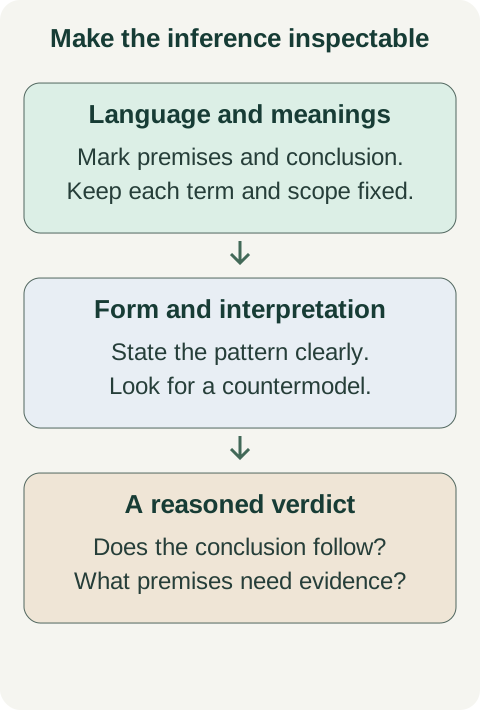
Start by marking premises and conclusions. Next clarify ambiguous terms, the scope of 'all' and 'some', and the direction of conditional claims. Test simple forms with possible cases or small truth tables. Then explore proofs and interpretations to see how a formal system organizes these relationships. This route gives a purpose to notation rather than making symbols the starting point.
The examples here use introductory classical reasoning. Logic includes further languages, systems and philosophical questions, and ordinary argument assessment may also involve qualified evidence. Use the induction and deduction pages to examine that boundary, and the separate validity and conditions worksheets for more practice with specific forms.
Further reading: Timothy Shanahan, Internet Encyclopedia of Philosophy · Stanford Encyclopedia of Philosophy
Check the reasoning
Why is the third row the counterexample?
In that row U is false and C true. Under the specified material conditional, U implies C is true. The second premise C is also true, but the conclusion U is false. That true-premise, false-conclusion combination refutes the reversed argument's validity. A row with a false premise would not do that.
Does a false conclusion anywhere in a table prove invalidity?
No. The premises must all be true in the same row. Validity is a conditional guarantee about cases where the premises hold. A false conclusion alongside a false premise does not challenge that guarantee. Mark the premises and conclusion before deciding which rows count.
Does U implies C mean that every stored copy came from an upload?
No. It rules out a case with U true and C false under the specified classical reading. It does not rule out C when U is false. An exclusive claim about how copies are created would be an additional premise. This distinction is the reason the reversed inference fails.
What if the package is outside rather than in either named room?
That would make the either-or premise inaccurate in the actual situation. The inference from 'hall or office' and 'not office' to 'hall' remains valid under those premises. A missing possibility is therefore a premise issue, not a refutation of that logical pattern. Correct the account of the possibilities before relying on it.
Can a formal proof settle whether an actual upload happened?
A proof can establish a consequence of the assumptions within its system. It does not by itself establish that a real file satisfied those assumptions. Evidence about the upload remains necessary. Keep the proof's stated premises separate from the factual justification for accepting them.
Sources and further reading
References checked on 2 November 2026. Examples are constructed for explanation.
- Deductive and Inductive Arguments
Timothy Shanahan, Internet Encyclopedia of Philosophy
Selected introduction and sections on necessity, validity, formalization, general-to-particular definitions and evaluation. The article also challenges simple categorical classifications; its proposals are not all presented here as a consensus.
- Classical Logic
Stanford Encyclopedia of Philosophy
Introduction and the complete semantics section: formal language, derivability, interpretation, validity and satisfiability. The explanations below use small original examples rather than reproduce the entry's proofs.