Logic and reasoning · An introduction
Deduction
Deductive evaluation asks whether a conclusion must hold if its premises hold. The crucial word is 'if': a valid route can preserve truth without establishing that the premises are actually true. Learn the route by testing forms, constructing counterexamples and separating validity from soundness.
Updated
Keep three questions about an argument separate
| Question | What establishes it? | What it does not establish |
|---|---|---|
| Is the form valid? | No possible true-premise, false-conclusion interpretation. | That the stated premises match the actual situation. |
| Are the premises true? | Evidence or an appropriate justification for each premise. | That the inference from them is valid. |
| Is the argument sound? | Validity together with true premises. | A claim that every deduction or attempted deduction succeeds. |
| Is the conclusion true? | It may be known through this argument or other evidence. | That this particular argument provides a good route to it. |
| Is there a proof in a system? | A sequence justified by that system's rules. | An automatic guarantee about every proposed rule or every formal system. |
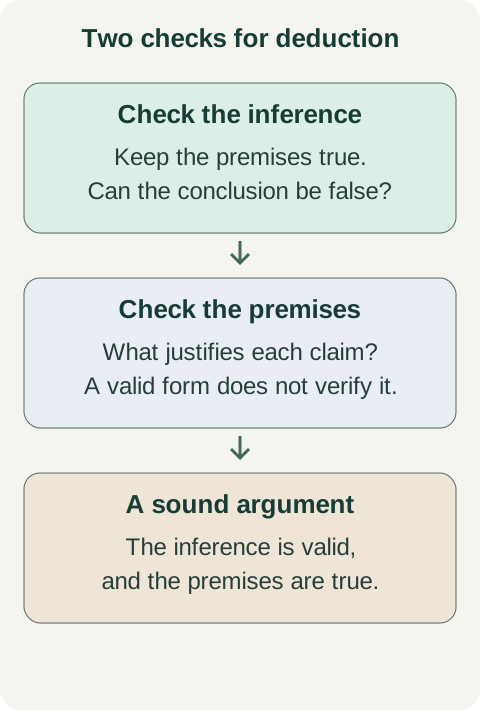
Validity is a conditional guarantee
An argument has premises offered as reasons and a conclusion supported by those reasons. In a valid deduction, the premises cannot all be true while the conclusion is false. This is a relationship among statements. It is not a psychological claim that a listener feels certain, and it is not a claim that the premises have already been verified.
The distinction matters whenever reasoning uses a rule, definition or stated assumption. You can correctly derive a consequence of a hypothetical rule even when no actual institution follows that rule. When the question concerns the real world, the inference check must be followed by a premise check. Do not let the appearance of logical certainty erase that second task.
Further reading: Timothy Shanahan, Internet Encyclopedia of Philosophy · Stanford Encyclopedia of Philosophy
A valid argument about a fictional catalogue
Take two premises: every catalogued reference volume has an identifier; the atlas on the desk is a catalogued reference volume. The conclusion is that the atlas has an identifier. If both premises hold, denying the conclusion would conflict with the stated universal rule and the atlas's membership in the category. The inference is valid.
Now ask whether those premises are true. Does the catalogue actually assign identifiers to every reference volume, and is this atlas included? A new, uncatalogued book would not refute the form; it would undermine the second premise if someone incorrectly described it as catalogued. A catalogued reference volume without an identifier would challenge the first premise. Identify which claim is at issue before announcing that the deduction has failed.
Further reading: Timothy Shanahan, Internet Encyclopedia of Philosophy · Stanford Encyclopedia of Philosophy
A reversed conditional needs a counterexample test
Consider a different hypothetical rule: if a scheduled bell rings, a light comes on. The light is on. Therefore the scheduled bell rang. That conclusion is not guaranteed. A maintenance switch could turn the light on while the bell remained silent. The rule and the observation would both be true in that situation, while the conclusion would be false.
In symbols, the pattern is P implies Q; Q; therefore P. It is called affirming the consequent. Compare it with P implies Q; P; therefore Q, the valid pattern called modus ponens. The similarity of the wording can conceal the reversal. The counterexample identifies the precise missing guarantee: Q might hold in a situation where P does not.
The hypothetical maintenance switch is not offered as a report about a particular device. It describes a possible situation allowed by the stated premises. For invalidity, one such situation is enough. You do not need to show that the actual conclusion is false or that every real light has several causes.
Further reading: Timothy Shanahan, Internet Encyclopedia of Philosophy
A valid argument can use a false premise
Imagine a toy collection containing a red metal cube called A and a blue wooden block called B. Someone argues: every metal object is blue; A is metal; therefore A is blue. The general-to-instance form is valid, but the first premise is false in this collection. A is the counterexample to that premise. The argument is therefore unsound even though its form is valid.
Compare this with the bell argument. There the problem was that true premises allowed a false conclusion. Here the actual premises are not all true. These are different failures and require different repairs. Better evidence or a corrected premise addresses the collection case; changing the inferential route addresses the reversed conditional.
Further reading: Timothy Shanahan, Internet Encyclopedia of Philosophy · Stanford Encyclopedia of Philosophy
Proofs and interpretations are related ways to study deduction
A formal deductive system supplies rules for deriving statements. A proof records steps justified by those rules. A semantics, by contrast, explains how the language's statements are interpreted and when they are true. Model-theoretic validity asks whether every interpretation satisfying the premises also satisfies the conclusion. These are connected but distinct approaches to the argument.
A system is called sound when its derivations preserve validity, and complete when every semantically valid argument of the relevant kind is derivable in it. Those are properties of the relationship between a system and its semantics. They should not be confused with the introductory claim that an individual sound argument is valid and has true premises. The SEP's account makes the different levels explicit.
Further reading: Stanford Encyclopedia of Philosophy
Valid arguments can have different directions
All catalogued atlases are reference volumes; all reference volumes have identifiers; therefore all catalogued atlases have identifiers. This valid argument moves from general statements to a general conclusion. A particular-to-general shortcut would not identify its validity. The better question concerns whether the conclusion can fail when the premises hold.
Likewise, a premise that Mina is a registered member supports the existential conclusion that there is at least one registered member, in an ordinary interpretation where Mina denotes a person. That conclusion is broader than a statement about Mina, yet the inference is deductive. The direction of the words is not a substitute for examining their logical relationship.
Further reading: Timothy Shanahan, Internet Encyclopedia of Philosophy
How to write a useful deduction verdict
State the premises before evaluating them. If the argument is invalid, describe a possible case in which they are all true and the conclusion false. Keep the meanings of the key terms fixed in that case. Quietly changing the meaning of 'catalogued' or changing which atlas is under discussion would not be a fair counterexample.
If the form is valid, explain which premise still needs evidence. Your verdict might be: 'the inference is valid, but we have not established that this atlas belongs to the category'. That gives the reader a concrete next investigation. 'It is deductive, so it must be right' confuses the kind of evaluation with its result.
Further reading: Timothy Shanahan, Internet Encyclopedia of Philosophy · Stanford Encyclopedia of Philosophy
Check the reasoning
Does a valid form establish that the catalogue is accurate?
No. Validity establishes a conditional relationship between the premises and conclusion. The catalogue rule and the atlas's membership need their own justification. If either premise is inaccurate, the form does not correct the record. A sound argument combines the valid relationship with true premises.
Why is the light-on argument invalid even if the bell really rang?
Its premises still permit the light to be on for another reason while the bell is silent. That permitted case has true premises and a false conclusion. The actual bell might have rung, but that would be information about this outcome, not a repair of the reversed conditional form.
Does the red cube refute the valid general-to-instance form?
It refutes the premise that every metal object is blue in the toy collection. The form remains valid: if every metal object were blue and A were metal, A would be blue. The example separates a false premise from an invalid inference. Confusing those failures makes it harder to identify what needs repair.
Can an argument be deductive but invalid?
In the common evaluative usage, an attempted deduction may be invalid. The IEP discusses competing ways to classify arguments, including accounts that use 'deduction' only for success. Whichever terminology you use, explicitly test the guarantee. Calling an inference deductive should not replace an analysis of whether it actually follows.
Why distinguish a sound argument from a sound formal system?
A sound argument, in introductory usage, is valid with true premises. A sound system has rules whose derivations preserve semantic validity. The first is a claim about one argument and its premises; the second is a claim about a system's relationship to its semantics. Similar vocabulary does not make them the same property.
Sources and further reading
References checked on 2 November 2026. Examples are constructed for explanation.
- Deductive and Inductive Arguments
Timothy Shanahan, Internet Encyclopedia of Philosophy
Selected introduction and sections on necessity, validity, formalization, general-to-particular definitions and evaluation. The article also challenges simple categorical classifications; its proposals are not all presented here as a consensus.
- Classical Logic
Stanford Encyclopedia of Philosophy
Introduction and the complete semantics section: formal language, derivability, interpretation, validity and satisfiability. The explanations below use small original examples rather than reproduce the entry's proofs.