Logic and reasoning · An introduction
Induction
Inductive reasoning uses evidence to support a claim that is not deductively guaranteed by that evidence. It may generalize from observations or predict a new case. Its usefulness depends on what was observed, how those observations were selected and why they are relevant to the conclusion.
Updated
Ask what connects the observed cases to the conclusion
| Check | Question to ask | A warning sign in the reasoning |
|---|---|---|
| Observed cases | Which observations are actually in the record? | An account of some cases is treated as a complete account. |
| Target | Does the conclusion concern this sample, the next case or a wider population? | The scope quietly changes from recorded mornings to every journey. |
| Selection | How did a case become part of the sample? | Only volunteers, easy-to-find cases or successful outcomes were counted. |
| Relevance | Why should these cases inform the unobserved ones? | The route, group, procedure or conditions have changed. |
| Missing information | What failed to be recorded, and could it matter? | Missing records are silently counted as successful observations. |
| Strength of conclusion | What qualification does the evidence support? | A limited record is used to claim certainty or an exact future probability. |
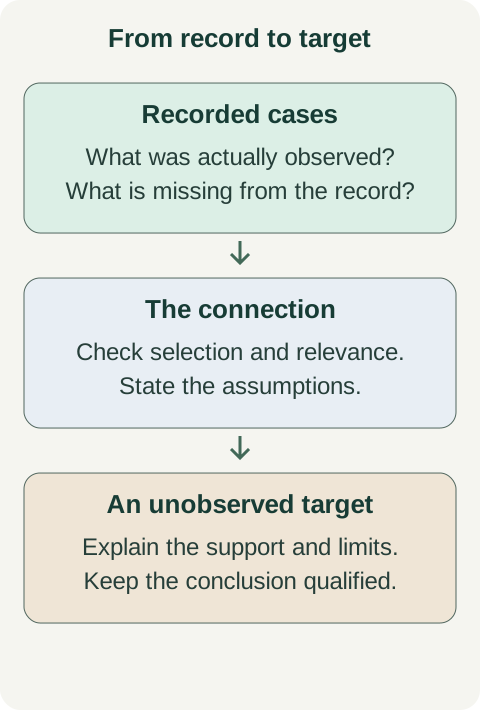
The conclusion goes beyond what was observed
A record describes observed cases. An inductive conclusion reaches further: perhaps to the next event, a larger group or an expectation about a pattern. The evidence can be useful without making every contrary outcome impossible. To evaluate the reasoning, identify exactly which step moves beyond the record and what supports that step.
This does not mean that induction is merely guessing. Evidence can make some conclusions better supported than others. But the support needs an explanation: relevant cases, reliable observations and a conclusion with an appropriate scope. Neither a confident speaker nor the word 'probably' supplies those connections on its own.
Further reading: Timothy Shanahan, Internet Encyclopedia of Philosophy
An invented bus record separates frequency from prediction
Imagine a notebook containing eight weekday morning bus arrivals on one route. Six were on time. If the record is accurate, six of eight, or seventy-five percent, describes those recorded arrivals. It is a statement about the notebook's eight cases. The conclusion that the next bus will probably be on time reaches beyond them.
To assess that prediction, ask which trip the next bus is making. Is it on the same route and at a comparable time? Did the timetable change? Were late arrivals recorded as carefully as early ones? Eight morning observations do not automatically represent evening trips, weekends or every route. The numerical fraction does not by itself establish a seventy-five-percent probability for any of those targets.
The relevant conclusion could be much narrower than 'buses are reliable'. Someone might say that this small record gives a limited reason to expect a similar weekday morning arrival to be on time, while further information could change that expectation. The qualification explains how far the evidence is being used. It does not turn the notebook into a complete probability model.
Further reading: Timothy Shanahan, Internet Encyclopedia of Philosophy
A larger sample can still have a selection problem
Suppose a fictional reading club asks for feedback only through its most active online group. Many members of that group respond enthusiastically. The responses establish what the respondents reported, assuming they were recorded accurately. They do not automatically establish that every club member shares the same view. People who never use the group had no comparable opportunity to respond.
Collecting more replies from the same selected channel may make that channel's views clearer while leaving the coverage problem in place. Ask how the sample relates to the target group. A relevant sampling procedure and reliable records can improve the basis for generalization; sheer size is not a substitute for explaining who was included and who was absent.
Voluntary feedback can still be valuable for a limited purpose, such as learning what participating members liked or disliked. The mistake is using it for a different conclusion without acknowledging the change. Specify whether you are describing respondents, group users or the whole club. Those are different targets.
Further reading: Timothy Shanahan, Internet Encyclopedia of Philosophy
Missing cases should stay missing in the argument
Return to the bus notebook. Perhaps the observer left before the bus arrived on two other mornings, so there is no arrival time for those trips. A blank entry is not an on-time arrival, and it is not automatically a late one either. It marks an observation that was not completed. Treating those blanks as successful trips would give the record a precision it does not have.
The missingness may also be relevant. If observation stopped whenever waiting became inconvenient, long waits could be underrepresented. That is a possible problem to investigate, rather than a fact already proved about the notebook. Good evaluation distinguishes the recorded cases, the missing cases and the reasons missingness might affect the conclusion.
Further reading: Timothy Shanahan, Internet Encyclopedia of Philosophy
New evidence can change the strength of an expectation
Suppose the timetable changes after the eight observations. The old record still describes the earlier trips, but its relevance to the new schedule now needs examination. Revising the expectation would not make the earlier observations false. It would acknowledge that the connection from those observations to the new target has changed.
Likewise, an exception can matter in different ways. One late trip falsifies the universal claim that every recorded trip was on time, but that was never true of the six-out-of-eight notebook. It need not falsify a carefully qualified expectation. Ask whether the original conclusion allowed exceptions before deciding what the new case defeats.
Further reading: Timothy Shanahan, Internet Encyclopedia of Philosophy
Predictions, universal rules and explanations have different tasks
An induction need not end with an 'all' statement. The prediction about the next bus concerns one particular future case. The general-to-specific versus specific-to-general slogan therefore misses some everyday reasoning. Compare the support for the conclusion, not only the grammatical shape of its sentences.
A proposal about why a bus was late poses another question: which explanation fits the available evidence? That is different from estimating a pattern of arrivals. Ordinary investigations can combine explanation, prediction and deductive consequences of stated rules. Dividing the investigation into its component claims helps you evaluate each connection rather than giving the whole task one reassuring label.
Further reading: Timothy Shanahan, Internet Encyclopedia of Philosophy
The practical evidence check leaves a deeper philosophical question
Improving a sample does not turn an evidence-based expectation into a deductive guarantee. The deeper philosophical issue concerns what justifies moving from observed experience to unobserved cases. The separate Hume reading guide follows that question in detail; it is useful after you can identify the step in an ordinary example.
For the present argument, write the actual record, the target conclusion and the assumptions connecting them. Explain what could strengthen or weaken that connection. A verdict such as 'the responses are useful for active group users but do not yet establish the views of the whole club' identifies a concrete limitation. It is more informative than declaring that all induction is good or that all uncertainty makes reasoning useless.
Further reading: Timothy Shanahan, Internet Encyclopedia of Philosophy
Check the reasoning
What exactly does six out of eight establish?
Assuming an accurate record, it establishes the frequency in those eight recorded arrivals: seventy-five percent were on time. It does not automatically establish a probability for the next arrival or a frequency for every route and time. Those further conclusions need a basis for treating the observed cases as relevant to the target.
Would a thousand online replies represent every club member?
The size alone does not answer the coverage question. If all replies come through a channel some members never use, those absent members remain unrepresented by that procedure. The record can still describe the respondents. Explain how people were included before moving from respondents to the whole membership.
Can blank arrival entries be counted as on-time trips?
No. A blank records missing information, unless another verified part of the record supplies the result. Counting it as an observed success changes the evidence. Keep completed observations separate from missing ones and investigate whether the reason for missingness could make the completed sample misleading.
Does one failed prediction show that induction never works?
No. An inductive expectation can allow exceptions. Examine the strength and scope of the original claim, the relevance of its evidence and what the new case changes. A universal certainty claim and a qualified expectation are not defeated in exactly the same way. Neither should be protected from criticism by a method's name.
Why does a changed timetable matter if the old observations are true?
Their truth concerns the earlier trips. A prediction about the new timetable depends on whether those observations still inform the new situation. The change may weaken that connection without changing what was previously observed. Separate the accuracy of the record from its relevance to the current target.
Sources and further reading
References checked on 2 November 2026. Examples are constructed for explanation.
- Deductive and Inductive Arguments
Timothy Shanahan, Internet Encyclopedia of Philosophy
Selected introduction and sections on necessity, validity, formalization, general-to-particular definitions and evaluation. The article also challenges simple categorical classifications; its proposals are not all presented here as a consensus.