Practical guide
Why Does Epicurus Say Death Is Nothing to Us? Read the Argument
Epicurus argues that being dead cannot be an evil for us because good and bad require awareness, and death ends awareness. The argument depends on that account of harm. Separate it from questions about the experience of dying, another person’s grief and the loss of a possible future.
Find the argument, not just its slogan
In the Letter to Menoeceus, Epicurus asks his reader to become accustomed to the thought that death is nothing to us. The next words explain why: good and evil involve awareness, while death removes awareness. A little later he gives the familiar non-overlap claim: “when we are, death is not come, and, when death is come, we are not.” [1]
Read those sentences together. The slogan alone can sound like a denial that mortality matters. The surrounding argument concerns a person supposedly undergoing something bad while being dead. Its conclusion depends on what counts as harm to that person and on the claim that awareness does not survive death.
The Stanford account places this argument in Epicurus’s embodied account of the soul: the soul does not retain sensation after the body can no longer support conscious life. That is the philosophical background being assumed, not a finding established by this reading exercise. The encyclopedia identifies the death passage as LM 124–125; the MIT display of Hicks’s translation does not number its paragraphs. [2]
Reconstruct the awareness and non-overlap steps
A useful reconstruction makes the premises visible instead of treating a memorable sentence as its own proof. This is our argument outline; it is not a facsimile of the ancient text.
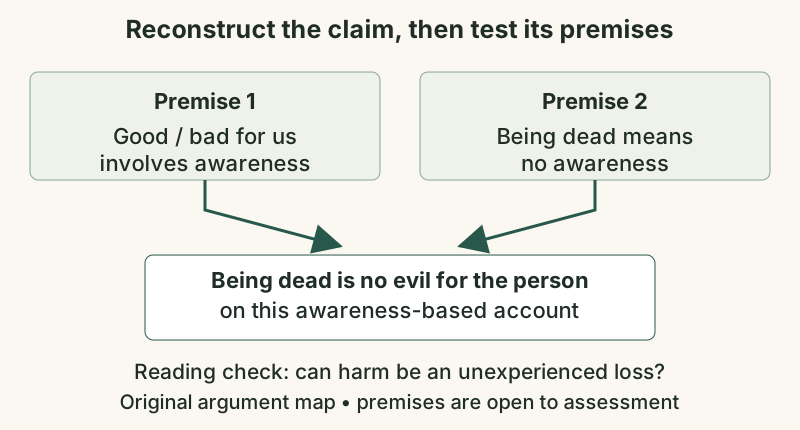
On a narrow screen, scroll inside the table or focus it and use the arrow keys.
| Step | Claim | Question to ask |
|---|---|---|
| 1 | Good and bad for us involve awareness. | Does every harm have to be experienced, or only a felt harm? |
| 2 | Being dead removes awareness in Epicurus’s account. | What view of the person and soul supports that claim? |
| 3 | We do not coexist with our own being-dead state: while we exist it is absent; when it arrives we no longer exist. | Is someone mistakenly imagining a continuing observer inside death? |
| Conclusion | Being dead is not an evil for the person, on the awareness-based account. | Does the conclusion address every possible meaning of losing a life? |
The third step blocks a picture in which “I” remain present to watch or suffer my own permanent absence. It works with, rather than replacing, the awareness premise. Someone who disputes that premise has identified an issue in the argument; simply repeating the non-overlap sentence will not settle it.
Distinguish following the reasoning from accepting every premise. You can explain why the conclusion follows within this account while still asking whether it uses too narrow a notion of harm.
Separate being dead from dying and from another person’s grief
The target is a state without awareness. Dying can include experiences while a person is still alive. Another person’s bereavement concerns that living person’s experience. Neither is identical to an experience supposedly occurring to the deceased after awareness has ended.
On a narrow screen, scroll inside the table or focus it and use the arrow keys.
| Question | Relation to the argument |
|---|---|
| Will I experience my own being dead as a painful condition? | This is the central imagined experience the awareness argument rejects. |
| Can the process of dying involve pain or fear? | The process can occur while awareness remains; the no-awareness premise does not erase those experiences. |
| Can another person grieve my death? | That is another living person’s experience, not my supposed experience of being dead. |
| Can death deprive someone of a possible future? | This introduces a different account of harm and needs another argument. |
Epicurus also challenges fear directed at a future condition that, in his account, will never cause an experienced annoyance when present. His point is about the object and grounds of that fear. It does not require us to pretend that someone presently feeling anxiety has no experience at all. The distinction is useful when reading the passage; it is not a promise that one philosophical argument will remove every kind of distress.
Test the premise with an objection about a lost future
Consider this objection, formulated here for the exercise: “A person could lose years of worthwhile life without later feeling that loss. Perhaps an event can be bad by depriving someone of goods, not only by producing a painful experience.” This is a challenge to the awareness requirement, rather than a claim that a dead person sits somewhere regretting the loss.
To assess it, identify the two accounts of harm. Epicurus’s passage connects good and bad with awareness. The objection allows a comparison between a life and the worthwhile future it could otherwise have contained. They need to argue about that difference; the fact that nobody experiences being dead does not, by itself, decide which account of harm to use.
The objection has questions of its own. Which possible future is the comparison using? Why is that future relevant to this person? In what sense is the deprivation bad for someone who no longer exists? Stating those questions is more precise than announcing that the slogan is obviously true or obviously false. No modern philosopher’s particular version of this objection is attributed here.
Read the passage’s positive claim about living
The letter says the right understanding of death makes a mortal life enjoyable by removing the yearning for unlimited time, rather than by adding immortality. It also compares choosing a more pleasant portion of food with choosing a more pleasant life, rather than merely the largest portion or longest time. [1]
Keep the emphasis on how the available life is lived. “Death is nothing to us” is not a recommendation to neglect living people or to prefer a shorter life. The letter describes the wise person as neither rejecting life nor fearing its cessation. These statements give the slogan a context that an isolated quotation loses.
A careful reading note can therefore say: “Epicurus denies that being dead will be an experienced evil for me, on his account of awareness. He uses that conclusion to address a fear of mortality. A deprivation objection challenges what counts as harm; it does not need to imagine an after-death sufferer.”
Try three argument and scope checks
These are fictional reading exercises. Each explanation identifies the inference at issue, rather than asking you to endorse Epicurus’s whole philosophy.
Case 1
A classmate writes: “Death removes awareness, so nobody can experience pain while dying.” What changed between the premise and the conclusion?
Show answer and explanation for case 1
The classmate substituted the process of dying for the state of being dead.
The awareness premise concerns the condition after awareness has ended. A process before that point can include experiences. The conclusion therefore moves beyond the stated premise; it does not follow merely from Epicurus’s description of being dead.
Case 2
A reader objects that death might deprive someone of a worthwhile future even if no later pain is felt. Must that reader be imagining a conscious ghost?
Show answer and explanation for case 2
No. The objection changes the proposed account of harm.
It can treat the loss of possible goods as a harm without positing an after-death experience. The dispute is then about whether awareness is required for something to be bad for a person, and about how a possible future is used in the comparison.
Case 3
Someone accepts Epicurus’s awareness premise and his claim that awareness ends at death. Can they consistently say that the deceased later feels their own permanent absence?
Show answer and explanation for case 3
That imagined experience conflicts with the accepted premises.
Feeling an absence would require an experiencing subject. Under the stated assumptions there is no such later awareness. This exposes a contradiction within the proposed picture; it does not settle objections that reject the awareness requirement itself.
Carry the right question into the next passage
If your next question concerns what a good mortal life needs, read the three kinds of desire. If you are puzzled by pleasure as a good, the pleasure and choice reading examines why an immediately pleasant option may be rejected. Those are different questions from whether being dead is experienced.
Sources and further reading
- Epicurus: Letter to Menoeceus — Hicks translation, MIT Internet Classics ArchivePrimary passages on death, desire and the good life. Paragraphs are located by their opening words; visibly damaged transcription sentences elsewhere are not quoted.
- Stanford Encyclopedia of Philosophy: Epicurus — Psychology and EthicsScholarly context for awareness, the death argument, desire categories and pleasure. Only this complete section and the entry’s Sources section were consulted.
- Stanford Encyclopedia of Philosophy: Epicurus — SourcesThe letter’s survival in Diogenes Laertius and its role as a concise presentation of Epicurean ethics.