Ethics · An introduction
Stoicism vs Epicureanism: Virtue, Pleasure and Everyday Choices
Stoic ethics treats virtue as the sole good and sufficient for flourishing. Epicurus identifies pleasure as the good, but does not recommend choosing every immediately pleasant option. Both ask for careful judgment; they differ over what ultimately makes a life go well. Their contrast is neither “feel nothing” versus “indulge everything” nor simply strictness versus comfort.
Updated
Different standards of a good life; shared need for careful action
| Question | Stoic account | Epicurus’s account |
|---|---|---|
| What makes a life go well? | Living in agreement with nature through perfected rational virtue; virtue is the only good and sufficient for flourishing. | Pleasure is the good; the Letter to Menoeceus emphasizes freedom from bodily pain and mental disturbance. |
| What is the status of pleasure? | Pleasure is not what makes a life good. It is among the things indifferent to flourishing, under the Stoic technical account. | Pleasure is good, but a particular pleasure can be rejected when its consequences make it an unwise choice. |
| Why pursue external conditions? | Preferred indifferents can call for appropriate, conscientious selection. Their possession is not the ultimate good. | Choices attend to needs, desires and consequences for pleasure and disturbance; sufficiency matters more than an unlimited demand. |
| What does a setback test? | How an agent uses choice and acts appropriately when the intended external result fails. | Whether a choice was prudently assessed, and how actual circumstances affect the pursuit of a pleasant life. |
| Are all feelings excluded? | No. The technical rejection of passions is distinguished from good feelings and reactions before assent. | No. The letter addresses fears and desires; it does not require rejecting every enjoyable experience. |
| Is care for other people irrelevant? | No. Duties and common concern are part of appropriate conduct, even though another person’s response is not ours to guarantee. | No. Stable pleasure is not equivalent to maximizing private indulgence; the letter stresses prudent and just living. |
| Which text should I read next? | Enchiridion 1 and 4 for choice and the bath’s two aims; sections 17 and 30 for roles and duties. | Letter to Menoeceus for desire classification, the selection of pleasures and the distinction between judgment and a fortunate result. |
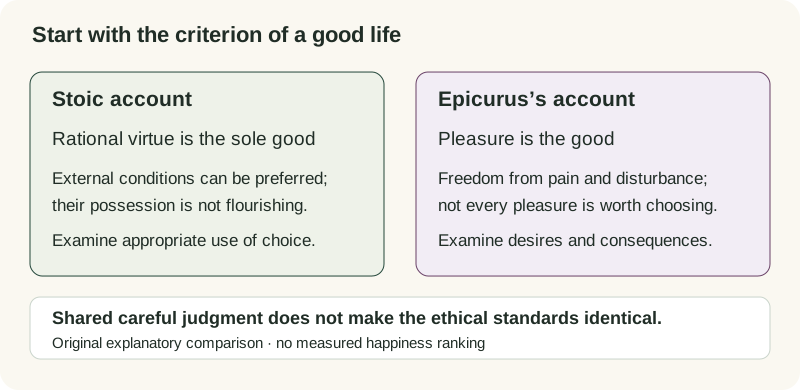
Compare the ethical ends before comparing habits
In the Stoic account, living well means living in agreement with nature. Virtue is the perfected condition of reason and the sole good; external advantages do not add to the virtuous person’s flourishing. That is a demanding philosophical thesis, not merely a preference for disciplined habits.
The Letter to Menoeceus identifies pleasure as the beginning and end of the blessed life. Epicurus also describes the relevant condition through bodily freedom from pain and mental freedom from disturbance. The claim concerns what counts as the good, rather than the largest collection of exciting experiences.
Ask the same question of both sides: what makes a life go well, and why? A person who follows a modest routine has not thereby supplied an answer. The same visible habit can be justified through different standards. The comparison table is based on the sources listed below, rather than imagined scores for happiness.
Further reading: Stanford Encyclopedia of Philosophy: Stoicism · Epicurus: Letter to Menoeceus, with scholarly ethical context · Stanford Encyclopedia of Philosophy: Epicurus
Stoic indifferents are not a recommendation to neglect things
“Indifferent” is a technical classification in relation to flourishing. Mainstream Stoicism distinguishes preferred indifferents from their opposites and allows conscientious pursuit of them in appropriate circumstances. It does not infer that someone should stop caring about a task because its successful outcome is external to choice.
The distinction between selecting appropriately and possessing an external result is crucial. A student can prepare an honest argument without controlling its reception. Epictetus’s bath example preserves an intended practical activity and an aim about the use of choice even when the activity is obstructed.
The general account also gives critics’ objections to treating external things as indifferent while making their selection rational. Those objections remain part of the philosophical debate. Do not erase the controversy by translating “indifferent” into “unimportant in every ordinary sense.”
Further reading: Stanford Encyclopedia of Philosophy: Stoicism · Epictetus: Enchiridion and selected scholarly context · Stanford Encyclopedia of Philosophy: Epictetus
Epicurean pleasure does not make every pleasure choiceworthy
Epicurus explicitly says that not every pleasure is to be chosen and that some pains can be accepted for greater later pleasure. The Letter therefore separates an experience’s pleasantness from the wisdom of choosing an action with its consequences. It does not provide a numerical utility formula.
The desire classification makes another distinction: natural desires divide into necessary and merely natural kinds, while groundless or empty desires form the other branch. The scholarly account explains how empty expectations of unlimited security or recognition can produce striving without a finite point of satisfaction.
This is why a luxurious object alone is a poor diagnostic test. Enjoying an optional variation and believing that one must always possess it to have a good life are different claims. The letter values sufficiency when little is available without forbidding enjoyment of every extra.
Further reading: Epicurus: Letter to Menoeceus, with scholarly ethical context · Stanford Encyclopedia of Philosophy: Epicurus
Apply both standards to one invented setback
Suppose a student has prepared a presentation honestly, the equipment fails, and a feasible spoken backup is available. Those are invented teaching conditions. The example supplies no actual study of stress reduction or learning outcomes.
An Epictetan reading asks about the two aims: making the presentation and keeping the use of choice appropriate when the first plan is blocked. Using an honest backup can be assessed separately from whether the equipment cooperates. The external failure need not imply an identical failure of conduct.
An Epicurean reading asks whether the preparation and response were prudently chosen in view of the circumstances and consequences, rather than treating a lucky outcome as proof of wise judgment. A feasible backup may be worth choosing under the supplied conditions. The ethical criterion remains pleasure and a prudent life, rather than replacing pleasure with the Stoic claim that virtue alone is the good.
Both accounts can make careful preparation intelligible. That overlap does not prove they have the same view of flourishing, and the example does not decide which philosophical standard is ultimately correct.
Further reading: Epictetus: Enchiridion and selected scholarly context · Epicurus: Letter to Menoeceus, with scholarly ethical context · Stanford Encyclopedia of Philosophy: Epicurus · Stanford Encyclopedia of Philosophy: Epictetus
Keep feelings and relationships in the comparison
The Stoic technical account of passions is not a denial of every possible feeling. The scholarly discussions distinguish good feelings and pre-emotions, including responses that arise before assent. Epictetus’s concern with the condition of choice also includes appropriate attention to other people and the common good.
Epicurus’s account is not an invitation to use other people only for an immediate thrill. The letter links pleasant living with prudent, honorable and just living. That conjunction is part of the text’s ethical account; the brief comparison is not claiming to reconstruct every Epicurean theory of friendship.
Neither position is established by a modern stereotype of the cold Stoic or the indulgent Epicurean. Describe the source’s evaluative claim first, then ask whether it adequately accounts for relationships, loss and ordinary vulnerability. Ancient theses about flourishing are not clinical findings about an actual person.
Further reading: Stanford Encyclopedia of Philosophy: Stoicism · Epictetus: Enchiridion and selected scholarly context · Epicurus: Letter to Menoeceus, with scholarly ethical context · Stanford Encyclopedia of Philosophy: Epicurus · Stanford Encyclopedia of Philosophy: Epictetus
Choose the next passage by the question you still have
For the distinction between your own choice and a guaranteed result, read Enchiridion 1 and 4. For how judgment relates to disturbance, read sections 5 and 20; interpret the strong claim without changing ethical harm into the assertion that physical injury is unreal. For relations and care, connect the actor metaphor in section 17 with the duties passage in section 30.
For Epicurus’s ethical choices, read the desire classification and the passage rejecting some pleasures. If the confusion is about the role of luck, read the letter’s final discussion of necessity, chance and our own agency. The reading links on this page lead to those independent questions.
Our Epictetan examples use selected handbook passages with scholarly context. The handbook is an abridgment associated with Arrian’s recording of Epictetus’s teaching; it is not a complete account of every early Stoic theory. The general Stoicism entry also notes the fragmentary survival of early school writings. Keep author, period and source scope visible when making broader claims.
Further reading: Epictetus: Enchiridion and selected scholarly context · Stanford Encyclopedia of Philosophy: Stoicism · Epicurus: Letter to Menoeceus, with scholarly ethical context · Stanford Encyclopedia of Philosophy: Epicurus · Stanford Encyclopedia of Philosophy: Epictetus
Test the inference
Decide what follows from each example before opening the explanation.
Case 1
In this invented case, an immediately pleasant option is expected to cause greater later trouble, while a mildly unpleasant preparation prevents that trouble. Does Epicurus’s praise of pleasure require selecting the first option?
Show explanation for case 1
No. The letter explicitly distinguishes pleasure as good from every pleasure being choiceworthy, and allows pain for later pleasure. The supplied consequences make a comparison necessary; immediate pleasantness alone does not settle the choice. The case has invented conditions, not measured utility scores.
Case 2
A reader says that health is a Stoic indifferent, so appropriate effort toward it must be excluded. What does the conclusion omit?
Show explanation for case 2
It omits the distinction between external possession and appropriate selection, along with the category of preferred indifferents. The mainstream account allows conscientious pursuit in normal circumstances while denying that possession is what makes a life good. That philosophical distinction is not practical advice to neglect health.
Case 3
Two students both prepare carefully for a presentation. One cites rational virtue and appropriate conduct; the other cites prudent choice in relation to a pleasant life. Does the identical visible action establish identical ethical theories?
Show explanation for case 3
No. A shared action can be supported by different criteria for flourishing. The example supplies an overlap in conduct, while the proposed reasons preserve the distinction between virtue as the sole good and pleasure as the good. A further argument would be needed to collapse the standards.
Common questions
Can I identify either school by whether someone enjoys a comfortable object?
No. A single possession or enjoyment does not reveal its justification. Ask how the person assesses virtue, pleasure, sufficiency and dependence, and distinguish an optional enjoyment from the belief that it is necessary for a good life.
Does this comparison rank which philosophy makes people happier?
No. It compares ancient accounts of flourishing and their reasoning. There are no measured outcomes, clinical trials or rankings in the teaching examples. Understanding the difference and accepting a theory are separate tasks.
Sources and further reading
References checked on 2026-11-07. Explanations and teaching examples are our own synthesis.
- Stanford Encyclopedia of Philosophy: Stoicism
Stanford Encyclopedia of Philosophy
Complete sections 1.1,1.3,4.1–4.4 and 4.7 consulted: source survival, ethical ends, virtue, indifferents, deliberation and passions. Underlying ancient works quoted there were not independently read.
- Epicurus: Letter to Menoeceus, with scholarly ethical context
MIT Internet Classics Archive; Robert Drew Hicks translation
Full displayed letter consulted, with visibly damaged transcription sentences excluded from quotation or silent reconstruction. The separate SEP Epicurus reference below supplies the consulted scholarly context.
- Epictetus: Enchiridion and selected scholarly context
MIT Internet Classics Archive; Elizabeth Carter translation
Displayed sections 1, 4, 5, 8, 17, 20, 30 and 48 consulted. Other handbook sections, original Greek and underlying Discourses not adopted; the separate SEP Epictetus reference below supplies scholarly context.
- Stanford Encyclopedia of Philosophy: Epicurus
Stanford Encyclopedia of Philosophy
Complete Sources and Psychology and Ethics sections consulted for pleasure, desire categories and the letter’s surviving evidence; rest of the entry not adopted.
- Stanford Encyclopedia of Philosophy: Epictetus
Stanford Encyclopedia of Philosophy
Complete Life and Works, Volition, Value, Emotional adjustment and Appropriate other-concern consulted. Underlying Discourses were not read.