Practical guide
Epicurus’s Three Kinds of Desire: Natural, Necessary and Empty
Epicurus first divides desires into natural and empty kinds, then divides natural desires into necessary and unnecessary kinds. A need with a point of satisfaction differs from an endless expectation of wealth or fame as a guarantee of security. To classify a case, examine what is wanted, why it is wanted and what would count as enough.
Read the two splits in the right order
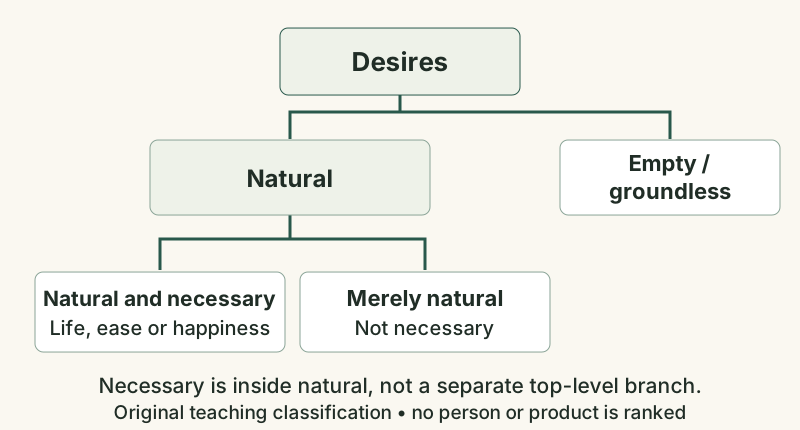
The Letter to Menoeceus first divides desires into natural and groundless kinds. It then divides the natural group: some desires are necessary as well as natural, while others are natural only. Hicks’s displayed translation uses “groundless”; the Stanford account calls the corresponding group “empty.” [1, 2]
That gives three kinds at the bottom of a nested classification: natural and necessary; natural but unnecessary; and empty. “Natural” and “necessary” are not three unrelated boxes beside “empty.” The second distinction operates inside the first natural group.
The letter further distinguishes necessary desires by their relation to happiness, freedom from bodily uneasiness and life itself. This is a philosophical account of what a good life requires. It is not a nutritional chart, a list of shopping recommendations or a diagnosis of a person.
Compare the three kinds and their evidence
On a narrow screen, scroll inside the table or focus it and use the arrow keys.
| Kind | Role in the account | Example or evidence boundary |
|---|---|---|
| Natural and necessary | Looks to life, bodily well-being or happiness. | The letter’s discussion of plain food removing the pain of want illustrates a need with a point of satisfaction. |
| Natural but unnecessary | An enjoyable variation need not be required to remove a basic lack. | SEP gives pleasant odors and good-tasting food and drink as examples; do not turn the examples into a complete list. |
| Empty or groundless | Rests on an empty belief about what will secure the good life. | SEP discusses immortality, great wealth and marks of fame when pursued as supposed guarantees of security. The interpretation concerns the aim and belief, not a price tag alone. |
A classification should preserve the reason for the label. “Necessary” answers a need question; “pleasant” describes an experience. Something can be enjoyable without being necessary, and a necessary good need not be pursued through the most elaborate available version.
The examples of wealth and fame need particular care. SEP explains the problem as seeking security through aims that do not provide the imagined guarantee and can drive limitless striving. That is an account of the empty expectation. It does not establish that earning money for an ordinary finite requirement is the same desire as demanding unlimited wealth.
Enjoyment and dependence are different claims
The letter values being content with little when little is available. It explicitly says this is not a rule to use little in every circumstance. It also says those least dependent on luxury can enjoy it sweetly. [1] A summary that simply forbids every enjoyable extra would miss that qualification.
Consider two statements: “I would enjoy this particular meal” and “Unless I always have this meal, a good life is impossible.” The first describes an optional enjoyment. The second adds a belief about necessity. Their object may look similar, but the second claim needs much more support.
Price does not resolve the distinction. A costly object might meet a specified need in particular circumstances; an inexpensive object might become the focus of a demand for endless approval. To use the classification, state what is being wanted and what it is supposed to accomplish.
Nor should the letter’s praise of simple fare be treated as a modern health guarantee. Its purpose here is to explain sufficiency, dependence and enjoyment. A claim about an actual person’s health requirements would need information the philosophical example does not supply.
Ask what would count as enough
A finite lack supplies a useful question: what would satisfy it? In the letter’s food example, removing the pain of want changes the situation. In an empty demand for an unquestionable guarantee of status or security, another acquisition or public mark may fail to reach a stopping point.
This is a reading test, not a mechanical formula. Ask why the aim is being pursued, what limit the person recognizes and what belief connects the object with happiness or security. If those details are missing, record the uncertainty instead of declaring the person vain.
The desire for human immortality is an example in SEP’s explanation of the empty category, within Epicurus’s account. It is not introduced here as a new scientific finding. Similarly, interpreting marks of fame through an expectation of permanent security does not prove that every kind of public achievement has one motive.
A useful note names the expectation: “In this fictional case, the character believes no amount of recognition can be enough unless everyone approves forever.” That specifies the unbounded demand being analysed. “They want a nice thing, so their desire is empty” would not supply the same reasoning.
Classify the aim before classifying the object
- State the desire as a sentence: who wants what, and for what purpose?
- Identify the claimed requirement: life, bodily ease, happiness, an optional enjoyment or a supposed guarantee.
- Ask what would satisfy it and whether a limit is recognized.
- Separate the object from the belief attached to it. Do not substitute its cost for the reasoning.
- Choose a category only as far as the stated circumstances support it; note what remains unknown.
Mixed motives are possible in a teaching case. A character may want a tool for a defined task and also imagine that owning the latest model will guarantee admiration. Separate those aims. The classification should not erase the finite task because another motive is present.
This method also explains why the two-school daily comparison is only an orientation. It introduces the question of unnecessary desire; the present reading supplies the nested categories and assumptions needed to answer a particular case.
Test three fictional cases
The circumstances below are invented to practice interpretation. The answers classify the stated aim, not an actual person’s health, finances or character.
Case 1
A character has enough of a plain meal in this teaching example and would enjoy an optional flavor variation. They do not think the variation is needed to live or to have a good life. Which category is the closest fit?
Show answer and explanation for case 1
Natural but unnecessary is the closest fit under these assumptions.
The example is an optional pleasant variation, like the taste examples in the scholarly explanation. The conclusion depends on the supplied sufficiency and lack of a necessity claim. It is not a general verdict on a food’s nutritional value or on another person’s circumstances.
Case 2
A character wants a fixed amount for a clearly stated task. Another wants ever more recognition because anything short of everyone’s permanent admiration feels like a failure. Is the shared fact that both want “more” enough to classify both as empty?
Show answer and explanation for case 2
No. The aims, beliefs and stopping conditions differ.
A finite task does not by itself establish an empty desire, and its full category may need more context. The second scenario explicitly supplies an unbounded expectation of security through universal recognition. Analyse that expectation rather than classifying every wish for an additional object together.
Case 3
A note lists “natural,” “necessary” and “empty” as three separate kinds, then puts all natural desires outside the necessary group. What is wrong with its diagram?
Show answer and explanation for case 3
It loses the nested relation in the letter.
Necessary desires are one part of the natural group, not a group wholly outside it. Natural desires split into necessary and merely natural kinds; empty desires form the other branch of the first split. Preserving that relation prevents “natural” from automatically meaning “necessary.”
Keep desire classification separate from the choice rule
A category helps explain a need or expectation. A choice still asks what follows from pursuing an option. Read why Epicurus does not choose every pleasure for that next question. His death argument addresses a particular fear; it should not be substituted for the complete classification of desires.
Sources and further reading
- Epicurus: Letter to Menoeceus — Hicks translation, MIT Internet Classics ArchivePrimary passages on death, desire and the good life. Paragraphs are located by their opening words; visibly damaged transcription sentences elsewhere are not quoted.
- Stanford Encyclopedia of Philosophy: Epicurus — Psychology and EthicsScholarly context for awareness, the death argument, desire categories and pleasure. Only this complete section and the entry’s Sources section were consulted.
- Stanford Encyclopedia of Philosophy: Epicurus — SourcesThe letter’s survival in Diogenes Laertius and its role as a concise presentation of Epicurean ethics.